The Boeing 747, often called the “Queen of the Skies,” represented a major leap in civil aviation when it entered service in 1970. Its size, range, and complexity demanded a larger flight crew than today’s long-haul aircraft. Alongside the captain and first officer, the 747 carried a third crew member: the flight engineer. This role was essential to managing the aircraft’s many mechanical and electrical systems, which at the time could not be automated or monitored by computer alone.
The Flight Engineer’s Role on the 747
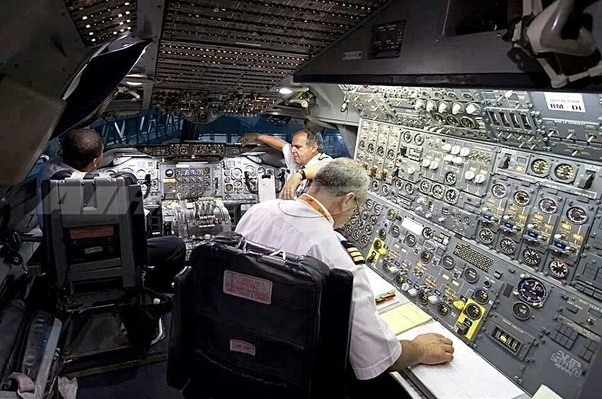
Unlike the pilots, who were focused on navigation and control, the flight engineer sat at a dedicated systems panel behind the captain’s seat. This station contained a dense array of gauges, switches, and warning lights for engines, hydraulics, pneumatics, fuel, electrics, pressurisation, and air conditioning. The engineer’s duties included:
- Monitoring fuel consumption and managing tank transfers to maintain balance.
- Controlling cabin pressurisation and air conditioning.
- Managing hydraulic systems and ensuring redundancy in case of pump failures.
- Overseeing the electrical system, including generators and load distribution.
- Recording system performance and diagnosing malfunctions in flight.
This workload was not optional. On an aircraft as large and complex as the early 747, the safe and efficient operation of the aircraft depended on someone whose sole task was to oversee the health of the systems while the captain and first officer concentrated on flying and navigation.
Regulatory and Operational Requirements
A three-crew cockpit was not unique to the 747. Other wide-bodies of its era, such as the Lockheed L-1011 TriStar and the McDonnell Douglas DC-10, also required a flight engineer. Aviation authorities considered the role essential for aircraft with certain system complexities, and operating procedures were written with three-person crews in mind. The flight engineer’s licence and training were highly specialised, bridging engineering knowledge with operational awareness.
Transition Toward Two-Pilot Flight Decks
By the late 1970s and early 1980s, rapid advances in avionics, digital monitoring, and automation began to make the flight engineer redundant. Microprocessors could now collect data from hundreds of sensors, display the information on electronic screens, and even trigger corrective actions automatically.
Aircraft such as the Airbus A310 and Boeing 757 were among the first long-haul types designed specifically for a two-pilot cockpit. Their electronic displays replaced the engineer’s panel, and centralised fault display systems simplified troubleshooting. With these innovations, regulators accepted that two pilots could safely operate even large wide-body jets.
Later Variants of the 747
The original 747-100 and 747-200 carried a flight engineer, but the final generation, the 747-400 introduced in 1989, eliminated the position. Its “glass cockpit” with electronic flight instrument systems (EFIS) and engine indication and crew alerting system (EICAS) gave the captain and first officer direct access to all system information. This marked the end of the three-person crew requirement in most commercial aviation.
The flight engineer was once indispensable to the operation of large aircraft such as the Boeing 747. Their role reflected the limits of technology at the time, when no computer could match the judgement and attention of a trained engineer monitoring hundreds of instruments. Modern avionics and automated monitoring systems absorbed these duties, allowing safe and efficient operation with only two pilots. The disappearance of the flight engineer position stands as one of the most significant changes in cockpit design over the last half-century, illustrating how technology steadily reshaped both the workload and the structure of flight crews.
By Aeropeep Team