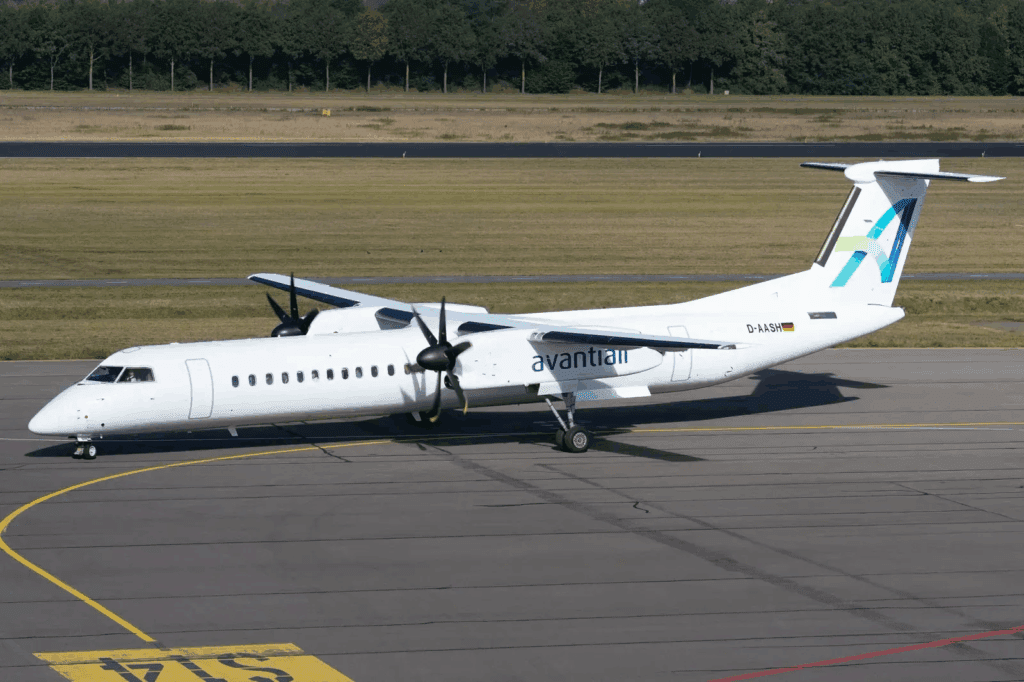
The De Havilland Canada Dash 8 Q400 (also designated Dash 8-400), commonly known as the Q400, is one of the most successful turboprop airliners in modern aviation. Designed for short-haul regional routes, this aircraft has become a favorite choice for airlines worldwide. Its balance of speed, efficiency, and cost-effectiveness makes it a strong competitor against regional jets and even narrow-body aircraft like the Airbus A320 when operating short sectors.
Technical Overview of the Dash 8 Q400
- Manufacturer: De Havilland Canada (currently owned by Longview Aviation Capital, previously manufactured by Bombardier Aerospace until 2019)
- Seating Capacity: 68 – 90 passengers (typically 78 passengers in standard configuration)
- Engines: 2 × Pratt & Whitney Canada PW150A turboprops
- Maximum Speed: Mach 0.64 (~667 km/h)
- Range: Approximately 2,500 km (1,350 nautical miles)
- Takeoff Distance: Approximately 1,402 meters (4,600 ft)
The Q400 is a stretched version of the earlier Dash 8 series, seating up to 90 passengers and representing the highest capacity turboprop on the market today. The advanced noise reduction system earned it the “Q” designation for Quiet. Its advanced turboprops deliver jet-like speed while burning significantly less fuel.
Why Is the Dash 8 Q400 So Popular?
- Fuel Efficiency – Turboprops consume 30–40% less fuel than regional jets on short routes under 600 nautical miles.
- Lower Emissions – With fuel savings comes a smaller carbon footprint, making it attractive for airlines under environmental regulations.
- Short Runway Performance – The Q400 can operate from shorter runways compared to jets like the A320, opening routes to smaller regional airports with various infrastructure constraints.
- Speed Advantage – It offers 30 percent faster cruise speeds compared to other turboprops, often just 15–20 minutes slower than a jet over 500–700 km routes.
- Reduced Operating Costs – Airlines benefit from the lowest unit cost in its class, allowing profitable operations even on low-demand regional routes.
Aircraft Purchase Cost
- Dash 8 Q400 (new list price): Approximately USD $32–35 million (Note: Current pricing may vary as production has been limited since ownership transfer)
- Airbus A320neo (new list price): Approximately USD $110 million
This significant price difference allows regional airlines and low-cost carriers to expand networks with a much lower capital investment.
Operating Cost Comparison: Dash 8 Q400 vs A320
- Fuel Burn (per flight hour):
- Dash 8 Q400: ~ 850–1,000 kg/hour
- A320: ~ 2,400–2,600 kg/hour
- Cost per Seat per Mile:
- Q400: 5–8 cents (depending on load factor and route length)
- A320: 7–10 cents (more cost-effective on longer routes with higher demand)
- Crew & Maintenance Costs:
- Q400 requires fewer crew members and has lower engine overhaul costs compared to a jet engine.
In summary, the Q400 is cheaper to purchase, cheaper to fly, and better suited for short-haul regional operations. The A320, on the other hand, is more efficient on medium-haul routes with higher passenger volumes.
Why Airlines Choose the Dash 8 Q400
- Regional connectivity where jet operations are uneconomical
- Ability to provide high-frequency services at lower cost
- Ideal for serving underserved markets with limited demand, enabling more frequent flights and lower fares
- Perfect balance between passenger comfort and operating efficiency
- High versatility with ability to serve as freighter, firefighting aircraft, and specialized missions
- Competitive edge in markets with thin demand but high frequency needs
The Dash 8 Q400 continues to be a popular aircraft because it fills a unique niche: fast, fuel-efficient, and cost-effective regional flying. Compared to the Airbus A320, the Q400 shines on shorter routes where lower operating costs outweigh speed advantages. For airlines seeking profitability in regional networks, the Q400 remains one of the smartest investments, though future availability may be limited given the current ownership structure and production status.
By Aeropeep Team