Tail strikes occur when the aft fuselage/tail contacts the runway during rotation, flare, go-around or rejected takeoff. Consequences range from cosmetic skin damage to catastrophic structural and systems failure (exposed wiring, ruptured hydraulics, compromised pressure bulkhead). This article explains how tail strikes happen, what systems are affected, the required inspections and repairs, return-to-service criteria, and prevention measures — illustrated with the Singapore Airlines 747-400 extended-scrape case (2003).
1. What is a tail strike?

A tail strike is any event where the aircraft’s tail or aft fuselage contacts the runway or other surface during flight operations. Typical phases:
- Takeoff rotation
- Landing flare
- Go-around with high pitch attitude
- (Rare) Rejected takeoff with tail-down attitude
Aircraft with long fuselages and limited tail clearance are more vulnerable (examples: A321, A330/A340, 747, 757, 767, 777, 787).
2. How tail strikes occur — common causes
- Excessive rotation rate: too-fast pitch change during takeoff.
- Premature rotation (below VR): rotating before required rotation speed.
- Incorrect takeoff performance data: wrong weight, temperature, flap or thrust settings.
- Aft center-of-gravity (CG): increases pitch sensitivity and over-rotation risk.
- Over-flare on landing: large aft control input before main gear contact.
- Go-around from low energy: abrupt pitch-up at low speed/altitude.
- Crosswind technique errors: late de-crab or excessive crab angle into flare.
3. Systems and structures affected

Structural elements
- Tail skid / bumper, lower aft skin panels, longerons, frames, stringers, tail cone, aft pressure bulkhead.
Systems
- Electrical wiring harnesses, grounding/bonding straps
- Hydraulic lines and fittings (leak / rupture risk)
- APU compartment and associated fuel/oil lines & fire loops
- Environmental Control System (ECS) ducting
- Flight control cables/linkages (elevator & rudder routing)
- Pitot/static/antennas and external appendages
Severity spectrum
- Minor: skid damage, abrasion—often patchable.
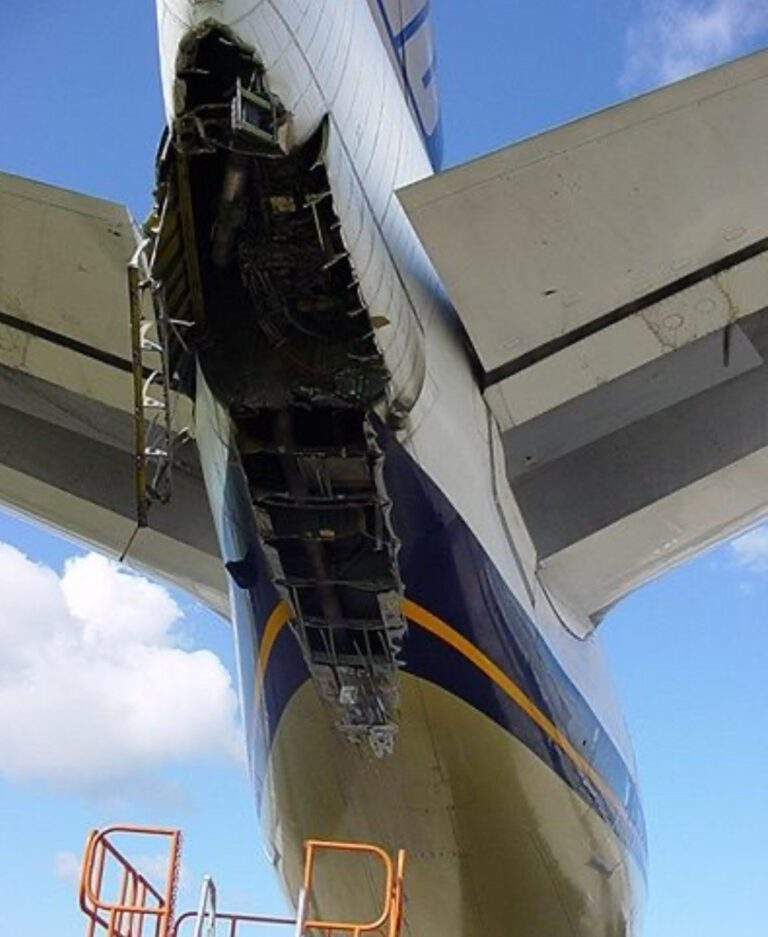
- Severe: torn panels, exposed systems, potential loss of pressurization—requires full structural repair.
4. Case Study — Singapore Airlines Flight SQ286 (B747-400, 12 March 2003)
Summary
- Tail scraped runway ~490 m during takeoff rotation at Auckland, producing major lower-aft fuselage damage and runway surface scars. No injuries; aircraft grounded for major repair.
Primary cause
- Weight transcription error: actual weight ~100 tonnes heavier than the value entered for takeoff performance → crew rotated 33 kt below required VR for true weight.
Sequence
- Incorrect takeoff weight entered into FMS/performance tools.
- VR and thrust settings loaded based on wrong data.
- Takeoff rotation at insufficient speed → over-rotation → tail contact.
- Extended scraping until aircraft gained enough speed to climb.
Key findings & systemic gaps
- No automated cross-check of entered weight vs load sheet.
- FMS accepted erroneous input without flag.
- Crew did not independently verify critical parameters.
- Lack of real-time weight sensing on that airframe.
Operational impact
- Substantial structural repair, runway repair, long grounding and high cost despite no injuries.
5. Inspection requirements after a tail strike (workflow)
Aircraft must be reported and grounded until cleared by maintenance and certifying staff.
A. Initial visual inspection (immediate)
- Inspect tail skid, lower aft skin, visible frames and skin deformation.
- Photograph and document damage extent and scrape length.
- Log the event in the technical log.
B. Detailed structural inspection (AMM / SRM)
- External and internal inspection of aft fuselage panels, tail cone, frames, longerons, stringers and aft pressure bulkhead.
- Measure deformations and compare to SRM allowable limits.
- Check structural alignment/symmetry; note heat-affected areas in long scrapes.
C. Non-destructive testing (NDT)
- Eddy current — surface/subsurface cracks in aluminum.
- Ultrasonic (UT) — internal delamination, thickness loss.
- Dye penetrant — surface-breaking cracks.
- Radiography (X-ray) — hidden internal defects.
- Thermography — detect heat-affected temper changes in extended scrapes.
D. Systems inspection & tests
- Hydraulic pressure/leak checks; replace/repair damaged lines.
- Electrical continuity, insulation, and bonding checks; harness inspections and re-routing as needed.
- Flight control rigging, cable tensions, and travel limits.
- APU fire-loop test; ECS duct pressurization test.
- Pitot-static and antenna checks where applicable.
6. Typical repairs by severity
Minor
- Replace/repair tail skid, blend or patch skin, corrosion protection and repaint.
Moderate
- Skin panel replacement or addition of doublers.
- Straighten/replace frames and stringers.
- Replace wiring harnesses and hydraulic lines.
Severe (extended scraping / torn tail cone like attached image)
- Remove & replace entire tail cone assembly or multi-panel fuselage sections.
- Install reinforcement doublers; perform full system replacements.
- Structural material analysis (check temper/strength if significant heat).
- Re-rig flight controls and restore all systems; pressure test aft fuselage.
Administrative / engineering
- SRM compliance or OEM engineering order (EO) required for repairs beyond limits.
- Manufacturer engineering support (Boeing/Airbus) when needed.
- Full hangar facilities with scaffolding and environmental control.
7. Return-to-service (minimum checklist)
All must be complete and documented before revenue flights:
- Structural repairs per SRM/OEM authorization.
- NDT and inspections confirm no residual cracking or deformation.
- All aft-fuselage systems verified serviceable (hydraulic, electrical, APU, ECS).
- Flight control rigging confirmed — full, free movement and correct tensions.
- APU fire detection & suppression tested.
- Pressure test of aft fuselage / bulkhead.
- Airworthiness release signed by authorized certifying staff.
- Technical log updated with full repair and test records.
- Functional check flight (operator/regulator requirement after major structural repair).
- Enhanced follow-up inspections scheduled for the affected airframe.
8. Prevention & mitigation strategies
Operational / human factors
- Dual independent takeoff performance calculations and mandatory cross-check.
- Electronic load sheet transmission to aircraft (eliminate manual transcription).
- Crew resource management (CRM): mandatory challenge & verify culture.
- SOPs limiting max rotation rate and prescribed pitch targets for takeoff/go-around.
Training & monitoring
- Simulator training focused on rotation rates, flare technique, and go-around pitch control.
- Flight data monitoring (FDM) to flag high-pitch events and trends.
- Line operations safety audits (LOSA).
Systems & design
- EFB integration with load planning systems and certified performance software.
- Onboard weight-sensing (landing-gear scale systems) on newer types.
- FMS logic enhancements to warn/flag unrealistic or out-of-range inputs.
- Tail-strike protection laws or flight-control pitch limit logic (in fly-by-wire aircraft).
Organizational
- Just-culture reporting and SMS that incentivize honest reporting and hazard sharing.
- Industry sharing of incidents and lessons learned.
9. Lessons learned — practical takeaways
- Transcription errors kill margins: large weight entry errors produce catastrophic performance miscalculations.
- Multiple independent checks are inexpensive compared to the cost of repair and operational disruption.
- Design + procedure together reduce risk: systems that flag improbable inputs + crew SOPs that require verification.
- Even “successful” flights can cause expensive damage — no assumption that a continued flight is safe without inspection.
By Aeropeep Team