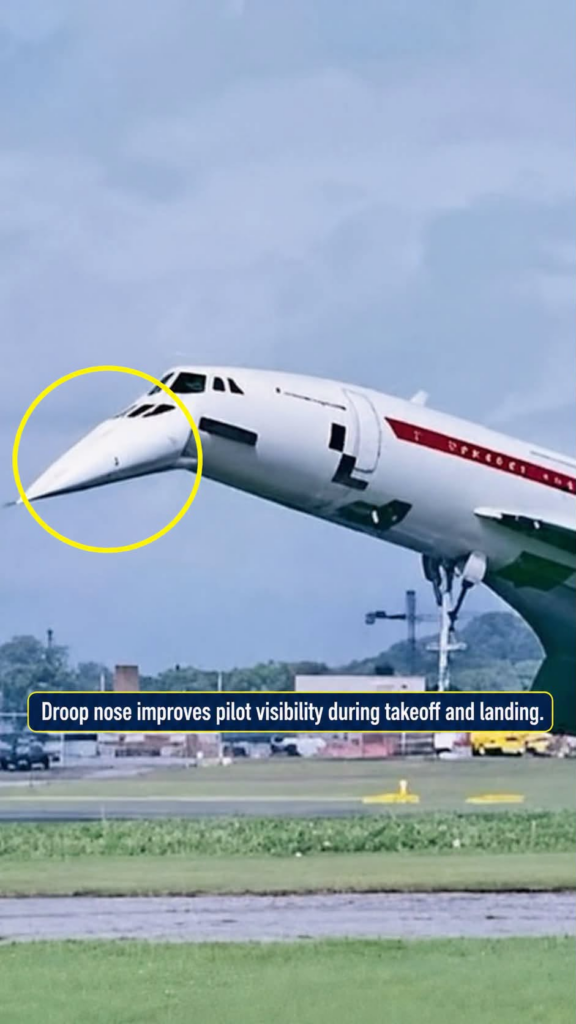
Of all the things that made Concorde instantly recognisable, nothing did more work than its nose. The long, needle-like profile that let it slice through the air at Mach 2 is also the reason it needed a second, hidden feature just to land safely: a droop nose that could hinge downward on command, along with a retractable visor that protected the windscreen at speed. It wasn’t a design flourish. It was the only practical answer to a visibility problem that a fixed supersonic nose simply couldn’t solve.
A Shape Built for Speed, Not for Seeing the Runway
Concorde’s aerodynamics were dictated almost entirely by one requirement: sustained cruise at Mach 2.02. That meant a long, slender fuselage and a thin delta wing, a combination optimised to minimise drag at supersonic speed. The same shape that made Concorde efficient in cruise made it almost unusable on the ground.
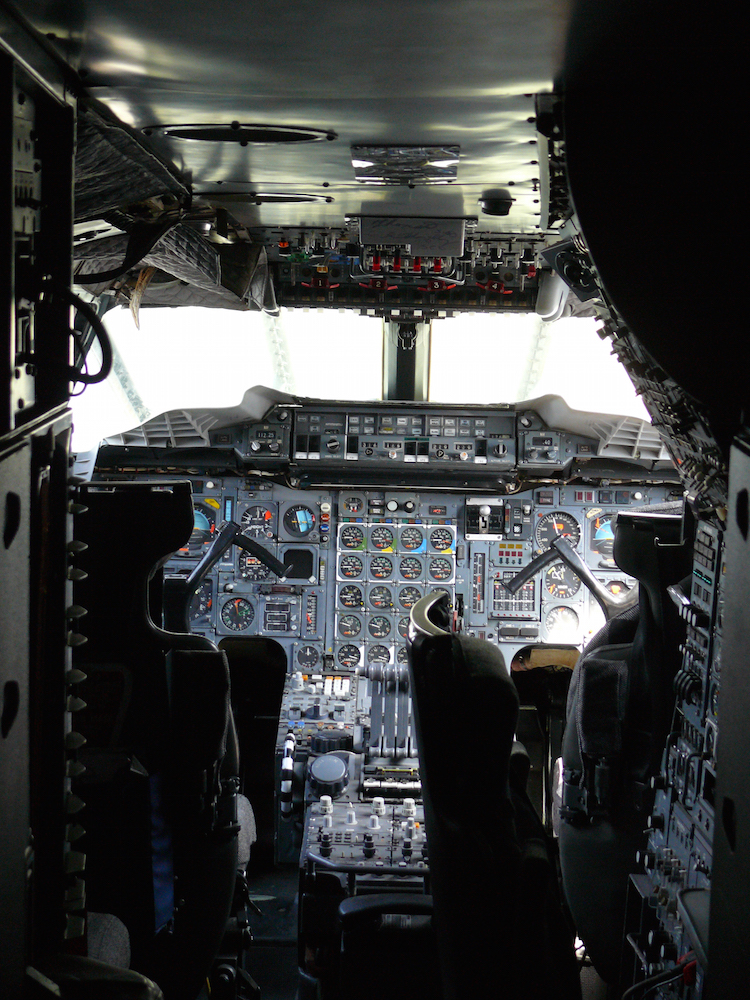
The cockpit sat high up on a long, tapering fuselage, and with the nose and visor both fully raised, pilots had only around five degrees of downward visibility through the windscreen — nowhere near enough to judge a runway on approach. The problem got worse, not better, at the exact moments it mattered most. Concorde’s delta wing didn’t rely on the leading-edge slats or trailing-edge flaps that give conventional swept-wing airliners extra lift at low speed. Instead, it generated additional lift through vortex lift, a fluid-dynamics effect that only works at a very high angle of attack. In practice, that meant Concorde had to fly nose-up during takeoff and landing far more steeply than a normal jet — pointing the fixed nose cone directly into the pilots’ sightline, right when they most needed to see the runway.
A fixed nose, in other words, wasn’t a design option at all. Something had to move.
Marshall of Cambridge and the Birth of the “Nez Basculant”
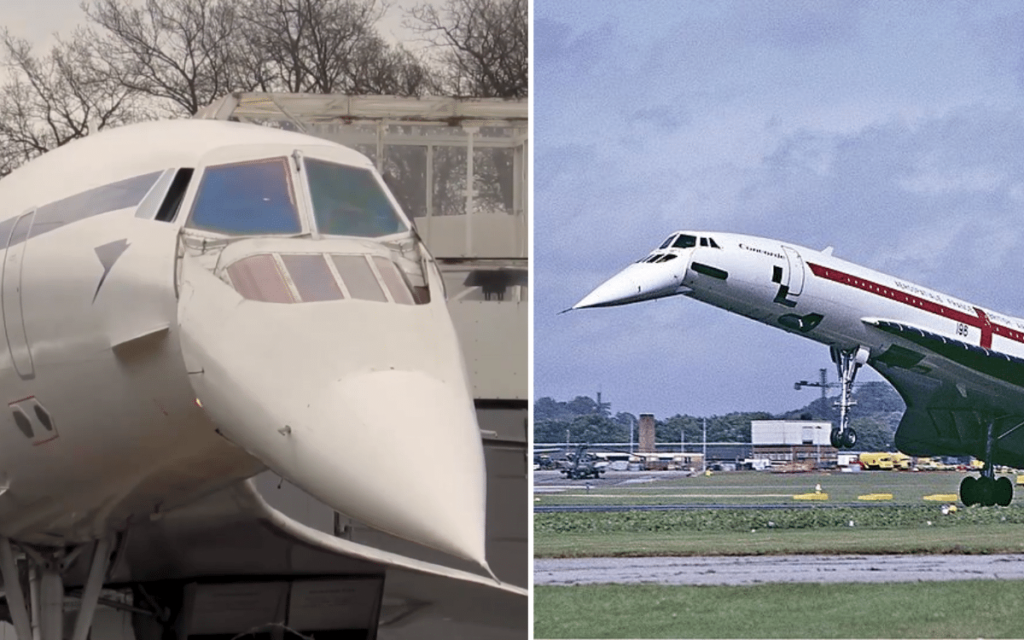
The solution came from Marshall of Cambridge (now Marshall Aerospace), working under contract to the British Aircraft Corporation’s Filton division, with the design effort led by engineer Norman Harry. Through the 1960s, the team developed what the French referred to as the nez basculant — literally, the “tilting nose.” Concorde’s actual droop-nose section was the forward, unpressurised part of the fuselage, hinged to the front of the pressurised cockpit shell. Structurally, the nose fairing ran roughly 15 feet 6 inches forward from the hinge point to the front bulkhead, and the hinge mechanism itself relied on curved “banana” fittings connecting the fuselage’s top and bottom longerons, with side loads carried through separate links into the nose bulkhead.
Before that final design was settled, the concept had already been proven in the air. A modified Bristol 221 research aircraft — itself a converted delta-wing test airframe — flew with an early droop-nose installation from 1964 through 1973, giving engineers years of flight data on the concept before it was locked into Concorde’s production design. That kind of long lead-time validation was typical of how much of Concorde’s more unusual engineering was de-risked before it ever flew a paying passenger.
How the Mechanism Actually Worked
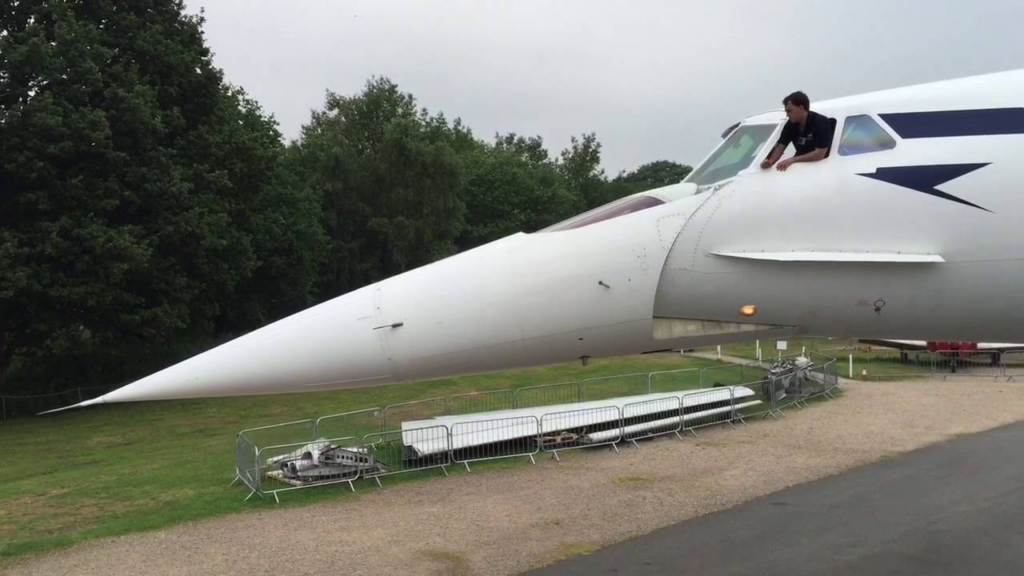
The droop nose was hydraulically actuated, powered by two of Concorde’s onboard hydraulic circuits — the “green” system for normal operation and a “yellow” system as backup, with a manual, gravity-driven emergency mode available if both failed. In service, the nose could move through its full range in a matter of seconds: reporting from the era put full droop at around 12 seconds, with retraction back to the streamlined position taking under 20.
Two working droop positions made it into production: five degrees for taxi, takeoff, and initial climb, and 12.5 degrees for final approach and landing. A steeper 17.5-degree position was tested early in the programme but abandoned — not because it failed structurally, but because pilots reported a disorienting visual effect at that angle, where the nose seemed to vanish from their forward view entirely. It’s a good reminder that even a purely mechanical engineering fix eventually has to satisfy the person flying the aircraft, not just the stress analysis.
Paired with the nose was a retractable visor fitted over the windscreen itself — necessary because, unlike the droop nose, the windscreen couldn’t simply hinge out of the way. At Mach 2, kinetic heating pushed skin temperatures past 100°C, and the visor’s job was to shield the windscreen glazing from that heat soak during cruise. Concorde’s prototype aircraft actually flew with a two-piece metal visor incorporating small periscope windows, but production aircraft switched to a single-piece glazed visor developed with Triplex, using laminated, heat-resistant glass roughly 1.5 inches thick — a change pilots reportedly welcomed, since the metal visor and its periscope arrangement gave a far more restricted view than a clear glazed panel.
Four Configurations, One Safety Interlock
Between the nose and the visor, Concorde’s crews had four distinct configurations available depending on the phase of flight: nose and visor both fully up for supersonic cruise and for parking; visor down with the nose still up for ground pushback or short subsonic legs; a five-degree nose droop with the visor retracted for taxi and takeoff; and the full droop with visor down for final approach and landing.
The system also had a built-in safety interlock that’s easy to overlook: whenever the visor was raised, the landing gear circuits were automatically isolated, making it mechanically impossible to lower the gear by mistake while the aircraft was still configured for high-speed flight. It’s a small detail, but it’s a good example of how much of Concorde’s design had to account for the consequences of getting a rare, high-speed-specific procedure wrong.
The Trade-Off Nobody Talks About As Much
The droop nose solved Concorde’s visibility problem, but it wasn’t free. Cutting a moving structural break into the forward fuselage meant the airframe needed substantial local reinforcement around the hinge points to handle the aerodynamic loads encountered at Mach 2.02 — loads a simpler, fixed nose cone would never have had to contend with. The 12.5-degree droop position also changed the aircraft’s low-speed handling characteristics, introducing pitching moments that flight crews had to actively manage during approach rather than simply trimming out. None of this made the system a design failure — it flew reliably across the entire commercial life of the fleet — but it’s part of why aviation writers and engineers still point to the droop nose as a feature that’s very unlikely to reappear on any future supersonic transport. Modern approaches to the same visibility problem lean toward synthetic and enhanced vision systems — cameras and sensors feeding a display — rather than a moving structural component that adds weight, complexity, and maintenance burden for a function that can now be solved electronically.
It’s worth stressing just how much extra weight and complexity that trade-off actually bought. Every additional hydraulic jack, selector valve, roller-guide rail, and lock in the nose and visor mechanism was mass that a supersonic airframe could otherwise have spent on fuel, payload, or structural margin — on an aircraft where every kilogram mattered far more than it does on a subsonic jet cruising well below the sound barrier. That the programme accepted the penalty anyway says something about how non-negotiable the visibility problem actually was: there was no lighter alternative on the table that still let pilots see a runway at a 5-degree cutoff. Only 20 Concordes were ever built in total, and of the airframes that remain today, most are preserved in a fixed nose-up display position simply because reactivating the original hydraulics — decades after retirement, on systems never designed to sit unused for that long — is its own significant engineering project.
Why It Still Matters
The droop nose is one of the clearest examples in commercial aviation history of a single mechanism resolving two conflicting requirements at once: an airframe shape purely optimised for supersonic cruise, and a cockpit that still needed to see a runway during ordinary subsonic operations. Get either half wrong, and the aircraft doesn’t work. Concorde’s answer was the same story that shows up again and again in aircraft design: performance, safety, and basic human factors pulling in different directions, with engineers finding an elegant, if not entirely free, compromise between them.
It’s also, quite simply, one of the reasons Concorde remains instantly recognisable more than two decades after its retirement. Photographers loved it, passengers noticed it on every approach, and today it’s one of the first things visitors ask about at the museums where preserved Concordes — including at Duxford, where the droop-nose mechanism on G-AXDN has since been restored and demonstrated again for the public — continue to draw crowds. A feature born entirely out of necessity became, almost by accident, the aircraft’s signature.
By – Aeropeep Team