
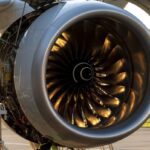
The landing gear is one of the most critical systems on any aircraft, designed to absorb loads during landing, provide directional control on the ground, and retract safely during flight. Among its components, the torque link assembly—commonly called the scissors link—plays a vital role in keeping the landing gear aligned and preventing wheel shimmy. The image above highlights the torque link on a commercial jet’s main landing gear, along with associated hydraulic lines and structural components.

What is a Torque Link?
The torque link (scissors link) is a hinged mechanism mounted between the upper and lower portions of the landing gear strut. Its primary function is to:
- Maintain wheel alignment: It prevents the lower strut and wheels from rotating independently of the upper strut.
- Absorb torsional loads: During taxi, takeoff, and landing, it handles twisting forces caused by uneven runway surfaces.
- Prevent shimmy: By restricting unwanted oscillations, the torque link ensures smooth ground handling and reduces stress on tires and bearings.
Components Visible in the Image
The uploaded image clearly shows several key elements of the landing gear system:
- Torque Link (Scissors Link): The triangular arm connecting the strut components.
- Hydraulic Lines: Flexible hoses running along the landing gear, supplying hydraulic fluid for braking and retraction systems.
- Oleo Strut (Shock Absorber): The chrome-plated cylinder that dampens landing forces using nitrogen and hydraulic fluid.
- Main Wheels and Tires: Bridgestone aircraft radial tires designed for high loads and cycles.
Inspection and Maintenance Requirements
Routine inspections of the torque link are part of line maintenance and A-checks. Key tasks include:
- Checking for play or looseness: Excessive free play can lead to gear shimmy, which is a safety hazard.
- Inspecting bolts and bushings: Wear on attachment points or bushings can compromise alignment.
- Monitoring for leaks: Hydraulic fluid leaks near the strut or brake lines, as seen in the photo, must be rectified immediately.
- Lubrication: Proper greasing reduces wear and ensures smooth articulation of the torque link.
Common Issues with Torque Links
- Excessive Free Play: Leads to nose or main gear shimmy.
- Worn Bushings or Bolts: Can cause misalignment.
- Cracks in the Link Arms: Structural cracks require immediate replacement.
- Hydraulic Fluid Contamination: Leaks around the strut area may appear to originate from the torque link.
Documentation and Rectification
When discrepancies are found during inspection, maintenance engineers refer to:
- Aircraft Maintenance Manual (AMM): For torque link inspection limits, lubrication schedules, and repair instructions.
- Minimum Equipment List (MEL): To determine if a defect is deferrable or requires immediate rectification.
- Technical Logbook (Tech Log): All findings and corrective actions are recorded for traceability and compliance.
Conclusion
The torque link may look like a simple mechanical hinge, but it plays an essential role in aircraft safety and ground handling performance. Proper inspection, lubrication, and timely replacement of worn components are vital to prevent landing gear shimmy and ensure operational reliability.
By understanding the importance of the torque link, aviation professionals can appreciate how small components contribute to the overall safety of complex aircraft systems.
By Aeropeep Team