
When most people see the BAe 146, also known as the Avro RJ, their first reaction is surprise: “Why does such a small aircraft need four engines?” At a glance, the BAe 146 looks like a regional jet that could have been designed with two engines, similar to the Embraer E-Jets or Bombardier CRJ series. Yet, this compact aircraft famously carried four turbofan engines under its high-mounted wings. The choice was not for speed or prestige—it was for practicality.
A Short Introduction to the BAe 146
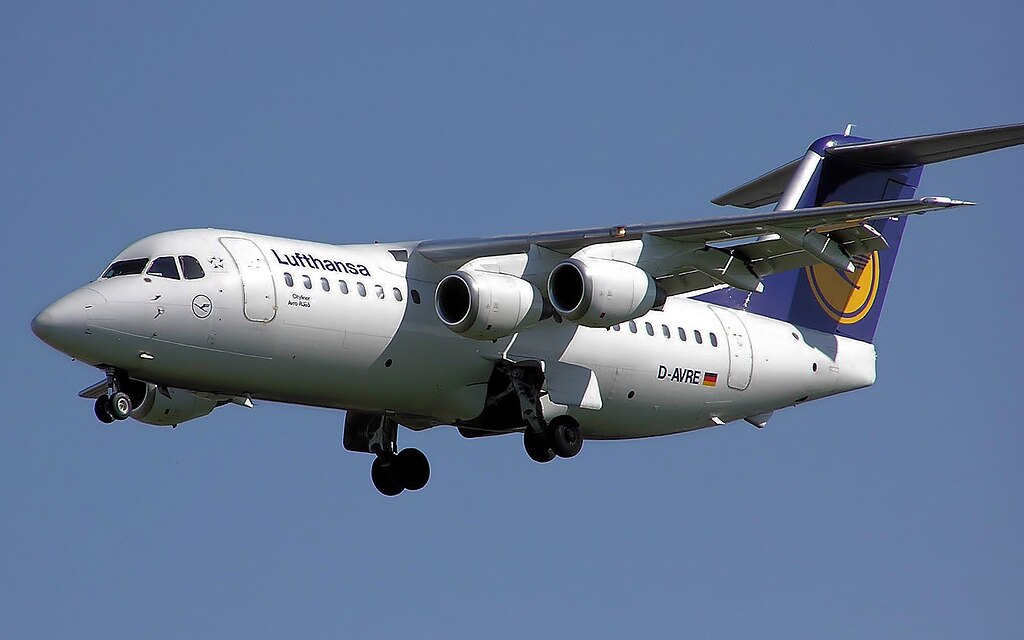
The BAe 146 was a regional jetliner developed by British Aerospace, with design work beginning in the early 1970s and production starting in the 1980s. It was built to carry 70 to 112 passengers depending on the variant (146-100, -200, and -300). It quickly became popular with airlines in Europe, Australia, and North America because of its unique ability to operate from short and quiet runways that larger jets couldn’t handle.
229 BAe 146 aircraft were built between 1983 and 1993, after which it was updated and marketed as the Avro RJ with improved engines, extending its service life well into the 2000s. Manufacturing continued until 2002 with just under 400 total airframes when including both BAe 146 and Avro RJ variants. Even today, modified versions are used for firefighting, freight, and military operations.
Why Four Engines on a Small Aircraft?
1. Low-Noise Requirement
One of the BAe 146’s biggest selling points was its exceptionally quiet operation. In the 1970s and 80s, noise restrictions around city airports like London City, Zürich, and Sydney were becoming stricter. The BAe 146 used four small Lycoming ALF 502 turbofans, which ran at lower thrust levels individually. Together, they produced enough power while remaining much quieter than two larger engines would have been at the time.
2. Short Runway Performance
The aircraft was designed for Short Take-Off and Landing (STOL). Smaller engines meant quicker throttle response and better distribution of thrust. With four engines, the BAe 146 could take off from short city-center runways and operate in places like London City Airport, which has one of the steepest approaches in commercial aviation.
3. Engine Technology of the Era
When the aircraft was designed in the early 1970s, twin-engine jets weren’t as efficient or certified for all routes. In that era, regulatory and engineering limitations meant that long flights over water or remote regions required more than two engines (ETOPS rules were not as flexible as today). By fitting four smaller engines, British Aerospace avoided these restrictions while still keeping the aircraft regional in size.
4. Safety and Redundancy
Operating into challenging airports meant extra safety margins were important. With four engines, the BAe 146 could lose one—or even two—and still land safely. For airlines, this provided reassurance when flying into airports with shorter runways and limited diversion options.
The BAe 146 in Service
- Airlines: It served carriers like British Airways, Lufthansa, Swissair, and Ansett Australia.
- Roles beyond passengers: Today, converted BAe 146s are used as aerial firefighting tankers, VIP transports, and freighters.
- Military use: The RAF and other air forces have deployed them as tactical transports and trainers.
Legacy of the Four-Engine Regional Jet
While modern regional jets use just two engines thanks to improved technology and looser ETOPS regulations, the BAe 146 remains a fascinating design. Its four engines were a deliberate solution to the challenges of its era: noise, safety, and performance from small airports.
The BAe 146 may no longer be a frontline passenger aircraft, but its unique design ensures it holds a special place in aviation history. With nearly 400 aircraft produced over two decades, it proved that unconventional solutions can succeed when they address real operational needs.
By Aeropeep Team