The Boeing 777, one of the most advanced wide-body twin-engine aircraft in the world, is renowned for its fuel efficiency and aerodynamic design. However, like all aircraft, the deployment of landing gear introduces significant changes in aerodynamic drag. In this article, we’ll compare the drag forces acting on the Boeing 777 before and after landing gear deployment, supported by real-world numerical figures and aerodynamic principles.
⸻
🔍 What Is Drag and Why It Matters?
Drag is the aerodynamic resistance an aircraft experiences as it moves through the air. There are different types of drag:
• Parasite Drag (includes form drag, interference drag, and skin friction)
• Induced Drag (from lift generation)
• Wave Drag (at transonic speeds)
When landing gear is retracted, the aircraft benefits from a clean aerodynamic profile, minimizing parasite drag. Once the landing gear is extended, the drag increases dramatically due to the non-streamlined structure of the gear components.
⸻
✈ Boeing 777 Drag Comparison: Before vs After Landing Gear Deployment
| Condition | Drag Force (approx.) | Drag Coefficient (Cd) | Fuel Burn Increase |
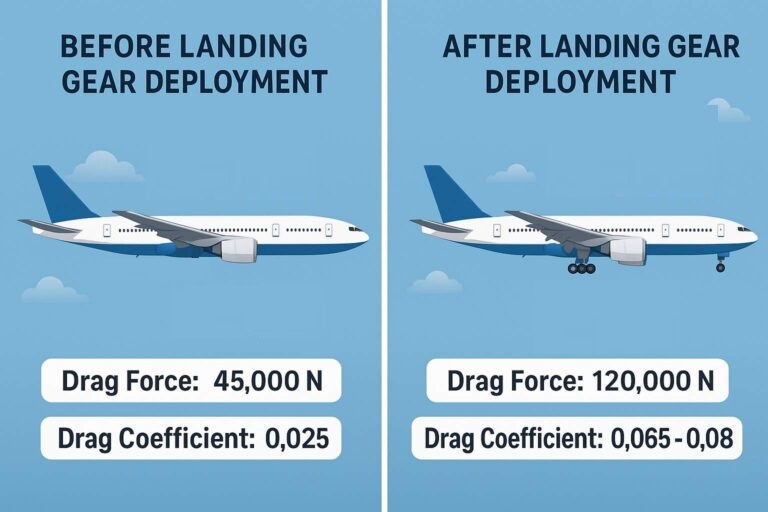
| Gear Retracted | ~45,000 N (at 250 knots) | ~0.025 | Optimal efficiency |
| Gear Deployed | ~120,000 N (at 250 knots) | ~0.065 – 0.08 | +5–10% increase/hour |
Key Observations:
- Drag triples after gear deployment due to exposed gear struts, wheels, and bay doors.
- Fuel consumption increases notably if gear is deployed too early or during go-arounds.
- Airframe stress and vibration may also increase slightly due to gear turbulence.
🧠 Technical Insights: Why Does Drag Increase?
The landing gear assembly of the Boeing 777 consists of:
- Main landing gear: 6-wheel bogies per wing, large and protruding
- Nose gear: Dual-wheel unit under the forward fuselage
When extended, these components disrupt the smooth airflow, leading to increased form drag and interference drag.
The drag coefficient (Cd) for the clean configuration is about 0.025, which jumps to 0.065–0.08 with gear down. The actual increase depends on additional factors like flap setting, spoiler extension, and altitude.
🔧 Real-World Scenarios: How Pilots Manage Gear Drag
✈ During Approach:
- Landing gear is typically deployed at 1,500 to 2,000 feet AGL.
- Deploying too early may result in unnecessary fuel burn and higher noise.
🛬 In Emergencies or Go-Arounds:
- Pilots may leave the gear down during a go-around to save time, accepting higher drag and fuel penalty.
🧮 Example Calculation:
Let’s calculate drag using the drag equation:
Drag = 0.5 × ρ × V² × S × Cd
Where:
- ρ (air density) ≈ 1.225 kg/m³ (sea level)
- V (velocity) = 250 knots ≈ 128.6 m/s
- S (wing area) = 427.8 m² (for B777-300ER)
- Cd (drag coefficient) = 0.025 (gear up), 0.07 (gear down)
Gear Up:
Drag ≈ 0.5 × 1.225 × (128.6)² × 427.8 × 0.025 ≈ 45,000 N
Gear Down:
Drag ≈ 0.5 × 1.225 × (128.6)² × 427.8 × 0.07 ≈ 125,000 N
📈 Why It Matters for Performance and Fuel Economy
- Airlines lose thousands of dollars per hour due to unnecessary drag.
- Boeing 777 burns about 6,800–7,200 kg of fuel per hour in cruise; an extra 5–10% due to gear drag can add hundreds of kilograms in wasted fuel.
- Accurate landing gear deployment timing contributes directly to operational efficiency.
✍️ Final Thoughts
The drag force on a Boeing 777 increases significantly after landing gear deployment, from about 45,000 N to over 120,000 N, depending on flight conditions. This drastic rise not only impacts fuel efficiency but also affects the aircraft’s handling and descent profile.
Understanding the drag dynamics before and after landing gear deployment is essential for pilots, aerospace engineers, and aviation enthusiasts. Whether you’re studying aircraft performance or optimizing flight operations, these aerodynamic principles play a critical role in every flight.