
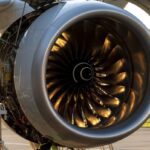
What You’re Seeing
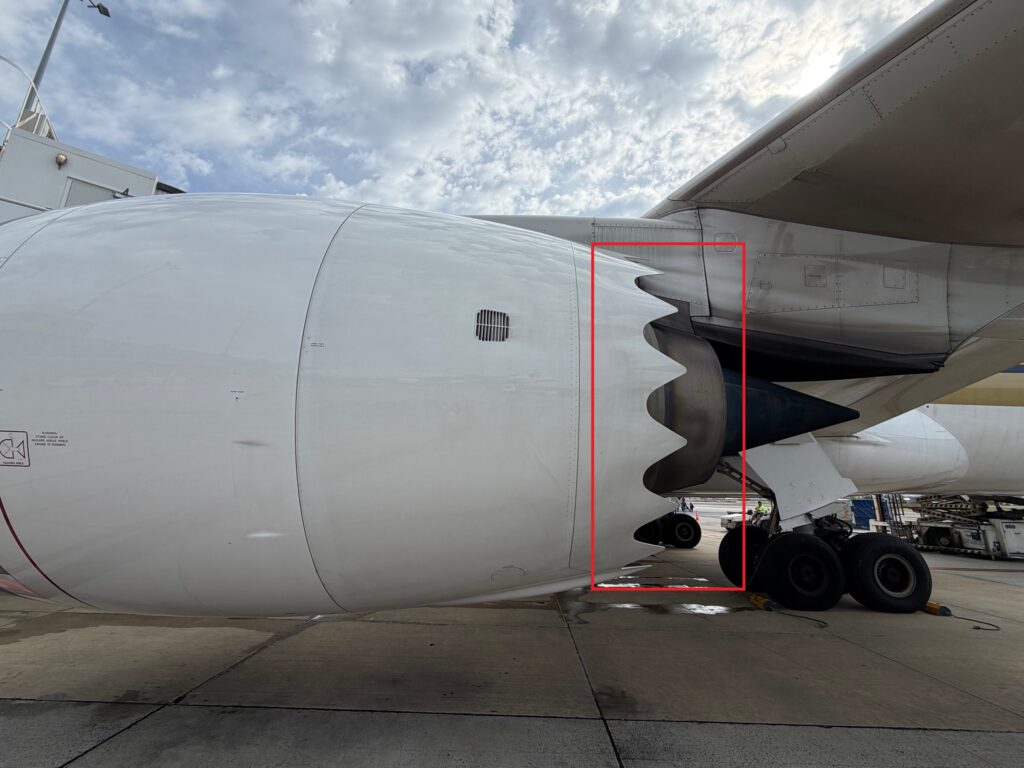
The serrated, saw-tooth pattern at the rear of the engine nacelle is called chevrons. These are a defining feature of modern high-bypass turbofan engines like the GE GEnx and Rolls-Royce Trent 1000 used on the Boeing 787 Dreamliner, as well as engines on the Boeing 737 MAX and other contemporary aircraft.
Instead of a smooth, circular trailing edge, the nacelle features triangular cutouts that create a distinctive zig-zag shape. These chevrons are precisely engineered to control how hot exhaust gases mix with cooler ambient air.
What Are Engine Chevrons?
Engine chevrons are triangular, serrated extensions or cutouts at the trailing edge of the engine nacelle and nozzle. They serve multiple purposes:
- Reduce jet noise significantly
- Improve exhaust flow mixing
- Minimize vibration and structural stress
- Support better overall engine performance
Chevrons represent one of the most effective noise-reduction technologies in modern commercial aviation, achieving their purpose with no moving parts and minimal weight penalty.
How Chevrons Reduce Noise
1. Controlled Mixing of Hot and Cold Air
The primary source of jet noise is the turbulent mixing between hot, high-velocity engine exhaust and the cooler, slower-moving ambient air. This creates intense shear layers that generate noise.
Chevrons alter the geometry of this mixing zone, promoting more gradual blending of the airflows.
Result:
- Reduced turbulence intensity
- Lower jet-mixing noise
- Quieter operation during takeoff and climb
2. Breaking Up Large Turbulent Structures
The serrated edge breaks large turbulent vortices into many smaller ones. This changes the acoustic signature of the engine.
Benefits:
- Reduces low-frequency rumble (the characteristic “roar”)
- Decreases community noise impact around airports
- Lowers cabin noise for passengers seated near the engines
3. Meeting Strict Airport Noise Regulations
Many airports worldwide enforce stringent noise limits. Modern standards include ICAO Chapter 14, which sets demanding cumulative noise targets.
Airports like London Heathrow, Los Angeles International, Sydney, and Frankfurt have noise-sensitive operations with curfews and penalties for louder aircraft.
Chevrons help aircraft like the 787 and 737 MAX meet these requirements without adding significant weight or complexity.
Aerodynamic and Performance Benefits
1. Improved Exhaust Flow Characteristics
Chevrons modify the pressure distribution at the nacelle trailing edge, creating a more favorable wake pattern. This results in:
- Smoother airflow around the engine pylon
- Better integration with wing aerodynamics
- Reduced interference drag
2. Reduced Structural Vibration
High-bypass turbofan engines generate significant pressure fluctuations where exhaust flows interact with ambient air. Chevrons help distribute these forces more evenly, which reduces:
- Engine pylon vibration
- Structural loads on wing-engine attachments
- Fatigue stress on components
This can extend component service life and reduce maintenance requirements.
3. Overall Efficiency Considerations
Chevrons do introduce a small amount of additional surface area and mixing drag. However, their benefits often outweigh this penalty:
- Elimination or reduction of other noise suppression systems saves weight
- Improved flow quality can enhance thrust efficiency in certain conditions
- Regulatory compliance enables airport access and operational flexibility
The net effect varies by engine design, but manufacturers report that properly designed chevrons contribute to overall aircraft efficiency when all factors are considered.
Why Chevrons Are Standard on Modern Aircraft
Aircraft noise has become critical for:
- Environmental sustainability – reducing aviation’s impact on communities
- Airport access – meeting requirements for expansion and operating hours
- Operational costs – avoiding noise penalties and curfew restrictions
- Passenger experience – quieter cabins improve comfort
- Regulatory compliance – meeting evolving international standards
Chevrons deliver these benefits with minimal added weight, no maintenance burden, and no operational complexity. This is why aircraft like the Boeing 787, 737 MAX, and Airbus A320neo family incorporate them as standard features.
Conclusion
The serrated nacelle edges visible on modern jet engines are a sophisticated aeroacoustic solution that addresses one of aviation’s most persistent challenges: noise. Engine chevrons demonstrate how thoughtful design can yield multiple benefits from a seemingly simple modification.
Key advantages:
- Substantial noise reduction (typically 3–4 dB effective perceived noise)
- Enhanced exhaust flow mixing
- Lower structural vibration
- Improved passenger comfort
- Compliance with stringent international noise standards
Chevrons exemplify the continuous innovation in aviation engineering, where small design changes can have significant impacts on aircraft performance, community relations, and environmental responsibility.
By Aeropeep Team