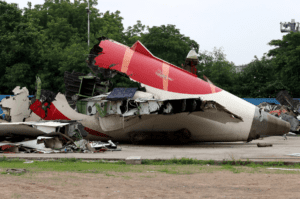


On June 12, 2025, Air India flight operated by a Boeing 787-8 Dreamliner (Registration: VT-ANB) encountered a serious technical incident during its operation in Ahmedabad, India. While the preliminary report is still under review, aviation experts are questioning whether software malfunction could have caused unintended system behavior — including the inadvertent closure of the fuel control valve, leading to power loss.
In this article, we explore the probability and mechanics behind software-based fuel system failures, especially on fly-by-wire aircraft like the Boeing 787, and what that could mean for aviation safety.
🧠 What Is a Fuel Control Valve and Why It Matters
The fuel control valve (FCV) is a critical component that manages the flow of fuel from the tanks to the engine. On modern aircraft like the 787:
- The FCV is electronically controlled via Engine Interface Units (EIUs).
- Pilots use the Fuel Control Switches in the cockpit to manage engine fuel supply.
- Software logic, not just physical inputs, determines how these valves operate during normal and emergency scenarios.
If the fuel control valve closes unintentionally, the engine may flame out — a situation as dangerous as a complete engine shutdown mid-flight.
🧩 Could a Software Malfunction Trigger a Fuel Cutoff?
Absolutely — and that’s what makes this theory relevant in light of the VT-ANB incident. Here’s how it could happen:
- Faulty Sensor Inputs: If the fuel system receives erroneous data (e.g., false high pressure or fuel leak signals), the system might automatically command the fuel control valve to close.
- Software Glitch or Logic Fault: A programming bug or memory fault in the Engine Control Unit (ECU) or EIU could issue an unintended command to shut fuel flow, even when no actual fault exists.
- Data Bus Failure: The Boeing 787 uses ARINC 664 (AFDX) for system communication. Corrupt or delayed messages might misinform the engine’s Full Authority Digital Engine Control (FADEC), resulting in an uncommanded closure.
- Flight Deck Integration Errors: If the Fuel Control Switch was selected to ‘CUTOFF’ inadvertently or its logic was misread by the system due to a UI or input bug, the fuel valve could close without human intention.
🔍 What Happened in the Air India B787-8 VT-ANB Case?
Although the final investigation is ongoing, preliminary data hints at engine power loss possibly due to fuel starvation or software miscommunication with engine components. Given the B787’s reliance on digital systems, the theory of a software-induced shutdown is now being closely examined.
If confirmed, it would not be the first time a digital fault has caused unexpected engine behavior. Past incidents with Airbus and Boeing aircraft have documented scenarios where software anomalies or miswired systems led to engine control problems.
🛫 Implications for Future B787 Operations
If a software vulnerability caused the FCV to close:
- Airlines may need to upgrade software patches across the fleet.
- Boeing might issue a Service Bulletin or Airworthiness Directive (AD).
- Pilot training may be updated to include recognition and mitigation of software-induced fuel control failures.
More importantly, aviation regulators may push for redundancy checks and manual override systems to counter digital overdependence in future aircraft designs.
💡 Final Thoughts
As aviation continues to evolve toward full digital integration, the risk of software malfunction cannot be ignored — especially in mission-critical systems like the fuel control valve. The Air India B787-8 incident could become a turning point in how we approach software reliability and human override authority in modern cockpits.
Until the full report is out, one question remains:
Can we trust code with the fuel supply to a flying machine carrying 300 souls?