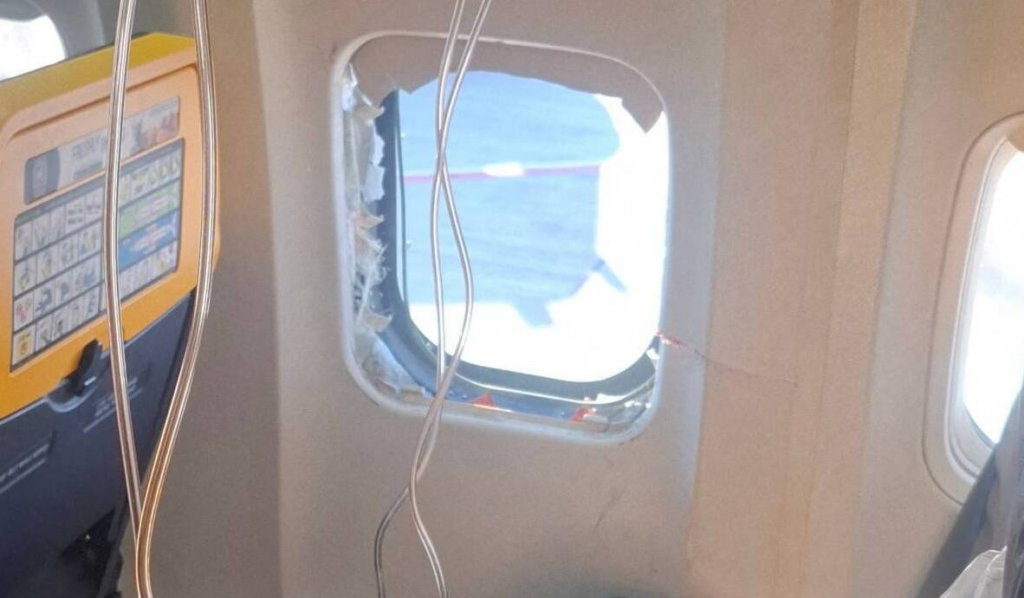
Investigation into the July 10 Thessaloniki–Memmingen incident shifts to the United States as new details emerge about the flight path and the damaged aircraft
What Happened
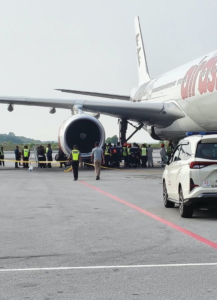
On the morning of July 10, 2026, Ryanair flight FR1879 — operated by Malta Air, a Ryanair subsidiary, using an 18-year-old Boeing 737-800 — departed Thessaloniki, Greece, bound for Memmingen, Germany. Roughly six minutes after takeoff, while climbing through approximately 15,000 feet, the aircraft suffered an explosive decompression event. A cabin window was blown out, reportedly after being struck by debris from a failure on the right engine.
A 61-year-old Serbian passenger seated next to the affected window was partially pulled out of the aircraft by the force of the decompression. Fellow passengers held onto him and dragged him back inside the cabin before the crew carried out an emergency descent to around 6,000 feet. The aircraft held at that lower altitude for about 30 minutes to burn off fuel before returning safely to Thessaloniki roughly an hour after departure.
The injured passenger suffered neck and shoulder injuries along with friction burns. He was treated at a Greek hospital; his injuries were not considered life-threatening. Ryanair confirmed one passenger required and received medical care after landing, and that a replacement aircraft later carried the remaining passengers on to Germany.
Jurisdiction Shifts to the NTSB
The investigation has now changed hands. Initial reports suggested the emergency unfolded in the airspace of the Republic of North Macedonia, which under international rules would have placed North Macedonia’s Aircraft Accident Investigation Committee in charge, with Greece, Boeing, the NTSB and the FAA assisting.
However, after a closer review of the flight path, the U.S. National Transportation Safety Board announced it has now taken over as the lead investigating authority, determining that the decompression actually occurred in Greek airspace rather than North Macedonian airspace. Under international aviation investigation rules, Greece’s Hellenic Air and Rail Safety Investigation Authority was entitled to hand the probe to the NTSB, given the U.S. connection through the Boeing-built airframe, and it has done so. Greece continues to participate in the investigation as an accredited party.
Engine Failure and Cabin Decompression
The NTSB has previously confirmed it was notified that the flight turned back due to “a right engine issue and cabin decompression.” Greek media and airport sources have indicated that part of the right engine failed in flight, with debris striking and shattering the passenger window — a chain of events investigators will need to formally establish through wreckage examination, engine teardown, and flight data analysis.
Ryanair has not publicly addressed the engine failure disclosed by the NTSB, and has offered only limited public comment on the incident overall.
Aviation safety experts note that events of this kind — an uncontained or partially uncontained engine failure sending debris into the fuselage and cabin — are extremely rare, since breaching a pressurized cabin in flight requires a specific and unlikely combination of failure and trajectory. Former airline captain Shye Gilad, who teaches at Georgetown University, explained that a window failure of this kind causes rapid decompression: a sudden loss of cabin pressure that creates a brief but powerful suction effect near the opening before pressure stabilizes. He credited the passenger’s seatbelt with likely preventing a far more serious outcome, reinforcing the standard advice to keep belts fastened throughout the flight, even when the seatbelt sign is off.
A Notable Detail: The Same Aircraft, the Night Before
Investigators are also looking at the aircraft’s very recent service history. The evening before the decompression event, the same airframe was operating a flight to Sarajevo when it was forced to return to Thessaloniki shortly after takeoff. That flight was subsequently cancelled. Reports indicate the diversion was related to a disruptive passenger rather than a technical issue, and there is currently no confirmed link between that event and the following morning’s engine failure and decompression — but the close timing means it remains a data point investigators will want to rule in or out as part of the technical record review.
What Investigators Will Be Looking At
With the NTSB now leading, alongside Greek, Boeing, and FAA participation, the technical focus of the inquiry is expected to include:
- Teardown and metallurgical analysis of the failed engine component(s) to determine the failure mode
- Examination of the damaged window and surrounding fuselage structure to confirm the debris strike sequence
- Flight data and cockpit voice recorder analysis covering the climb, the decompression event, the emergency descent, and the extended low-altitude fuel burn before return
- Maintenance and service history of the 18-year-old 737-800, including recent inspections relevant to the engine and airframe
- Crew and cabin response, including passenger handling during the emergency
Formal findings from investigations of this kind typically take months, and any final report with probable cause and safety recommendations is unlikely to be published in the near term.
Broader Context
The incident has drawn comparisons to the April 2018 Southwest Airlines Flight 1380 accident, in which an uncontained engine failure on a Boeing 737 also sent debris into a cabin window, resulting in a fatality after a passenger was partially pulled through the opening. That accident led to significant scrutiny of engine fan blade inspection intervals across the 737 fleet, and any parallel findings here could prompt renewed attention to inspection regimes for older 737-800s still in heavy rotation with low-cost carriers.
For Ryanair, the incident adds to a stretch of public scrutiny over operational and safety-adjacent events, and the airline’s handling of the aftermath — including its public communications — has drawn some criticism. The airline has stated only that the affected passenger received medical care and that passengers were rebooked on a replacement aircraft.
By – Aeropeep Team