
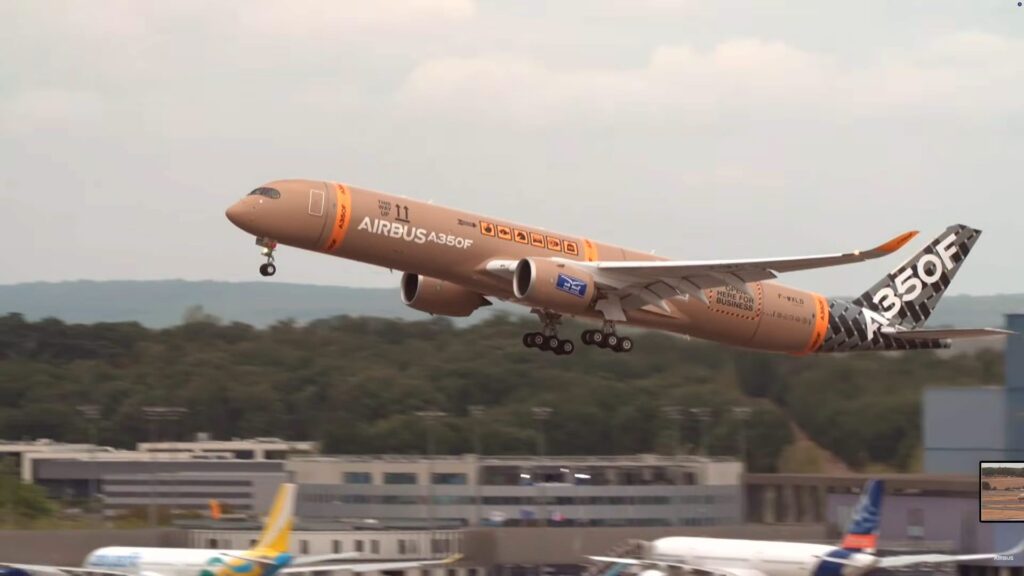
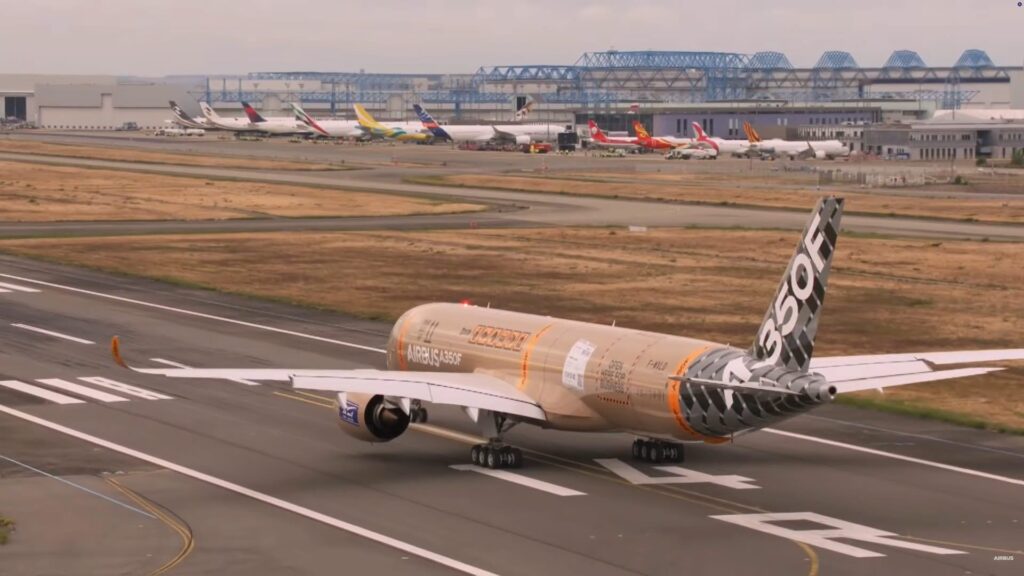
The first test aircraft, MSN700, registered F-WXLD, spent four hours and ten minutes in the air. It took off from Runway 14R at Toulouse-Blagnac at 10:30 local time. Airbus says the sortie checked basic airworthiness, handling qualities and the performance of key systems against predictions, and the aircraft reached 25,000 feet.
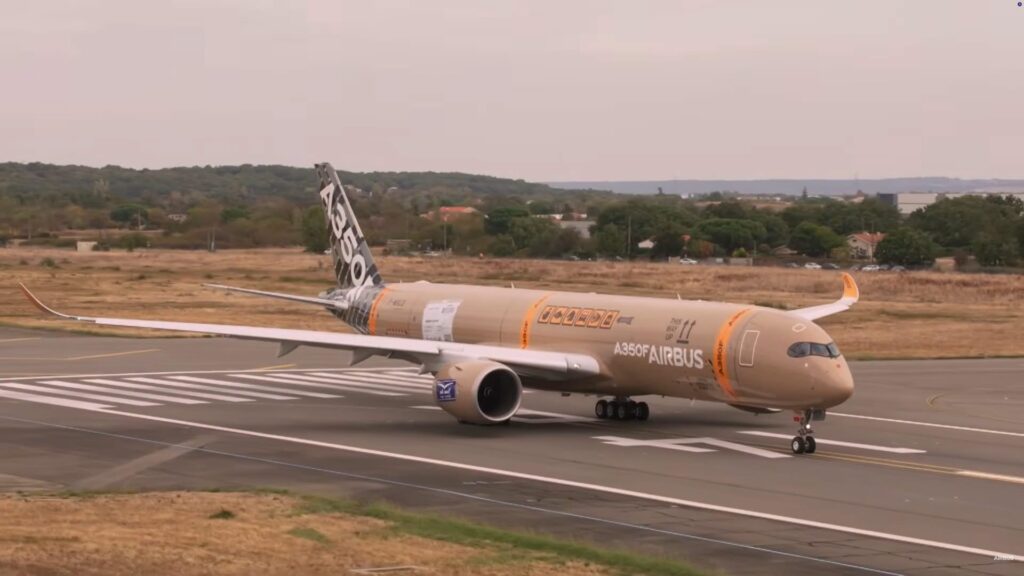
A five-person crew flew it: test pilots Bernardo Saez-Benito and Sylvain Guiraud, a test flight engineer and two flight test engineers. The aircraft wore a special parcel-inspired test livery.
A350F Payload and Range
The headline numbers are:
• Payload: up to 111 tonnes
• Range: up to 4,700 nm (8,700 km)
• Engines: two Rolls-Royce Trent XWB-97
These are design targets. Airbus’s capabilities still have to be validated through certification and were not demonstrated by the first flight. As with any freighter, range depends on payload, so the real question for operators is how far the A350F can fly with a full load on hot days and high-altitude airports.
Not an A350-900, Not an A350-1000
The A350F is not just a stretched passenger jet. Its configuration combines sections of the A350-900 and A350-1000, which gives it new aerodynamic and landing-gear characteristics. For engineers, this matters because loads, handling and gear behaviour are what flight testing has to prove. The Trent XWB-97 produces 97,000 lbf of thrust and was originally developed for the A350-1000.
A350F vs 777F: Key Differences
The 777F has been the benchmark large freighter for years. Here is how the two compare (777F figures are approximate published Boeing numbers, so check them before you publish):
Airbus A350F Boeing 777F
Max payload Up to 111 t (design) About 102 t
Range Up to 4,700 nm (design) About 4,970 nm
Engines Trent XWB-97 GE90-110B1L
Status Flight testing In service
First delivery H2 2027 target In service since 2009
The A350F offers more payload on paper, while the 777F still leads on stated range and, more importantly, on proven service history. Airbus claims at least 20% lower fuel burn and CO2 than competing freighters, and says the main deck cargo door is about 15% wider than the 777F’s. Those are manufacturer claims, and real airline operations will show how they hold up.
A350F Flight Test Campaign
The campaign is expected to last about nine months and use two aircraft. F-WXLD will fly about 300 hours focused on aerodynamic performance and handling, while the second aircraft, F-WCGO, will fly about 110 hours on environmental systems, smoke testing and operational maturity. That is roughly 400 hours in total.
A350F Delivery Timeline
Airbus launched the A350F in 2021 and originally targeted service entry in 2025. The date slipped several times, and first deliveries are now targeted for the second half of 2027. That target depends on the results of testing and certification.
Why the A350F Matters for Air Cargo
Large freighters are expensive assets, and operators choose them for fuel burn, payload density and reliability. If the A350F meets its targets, it gives airlines a modern alternative to the ageing 777F and 747-8F fleets. The programme is also a test of how well Airbus can turn a passenger design into a freight aircraft.
FAQ
When was the A350F first flight?
Tuesday 29 September 2026, from Toulouse.
What is the A350F payload?
Up to 111 tonnes, as a design capability.
What is the A350F range?
Up to 4,700 nautical miles (8,700 km).
What engines does the A350F use?
Two Rolls-Royce Trent XWB-97 engines.
Is the A350F better than the 777F?
On paper it has more payload and lower claimed fuel burn, but the 777F is proven in service. The A350F still needs certification and airline operating experience.
When will the A350F enter service?
Airbus is targeting first delivery in the second half of 2027.