
Science fiction makes it look easy. A pilot pushes a lever, the stars stretch into lines, and the ship leaps across the galaxy in seconds. In the real world, the question “can we build a space shuttle that travels at the speed of light?” runs straight into the hardest rules in physics.
In this article we look at how fast spacecraft actually travel today, why light speed is out of reach for anything with mass, what it would do to the human body if we ever came close, and what the aviation world has already taught us about chasing speed.
What Is the Speed of Light?

Light travels at 299,792 kilometres per second (about 186,282 miles per second) in a vacuum. Converted into the units pilots and engineers use every day, that is roughly 1.08 billion km/h, or about 580 million knots.
At that speed, light could circle the Earth about 7.5 times in a single second. It takes sunlight about 8 minutes and 20 seconds to reach us, and light from the nearest other star system, Proxima Centauri, needs about 4.2 years.
How Fast Do Spacecraft Actually Travel Today?
People often say “space shuttle” when they mean any spacecraft, so it helps to separate a few different records.
The Space Shuttle
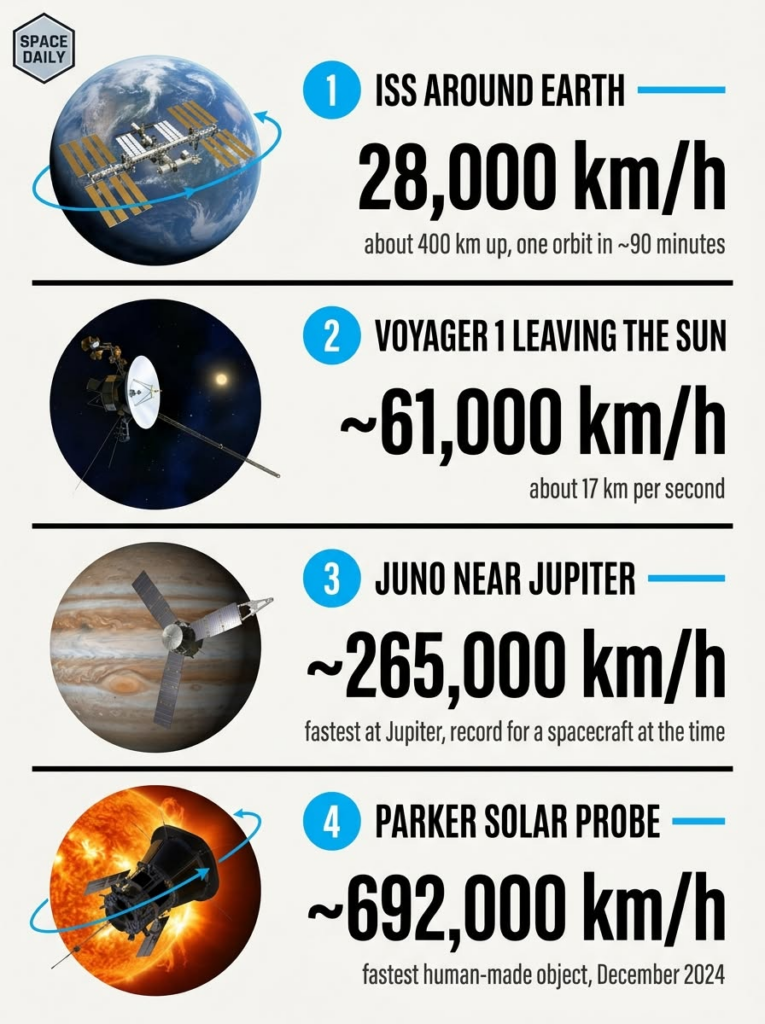
NASA’s Space Shuttle orbiter, retired in 2011, travelled at about 28,000 km/h (17,500 mph) in low Earth orbit. That is roughly Mach 25. It was fast enough to circle the planet every 90 minutes, but only about 0.0026% of the speed of light.
The fastest crewed spacecraft
The fastest humans have ever travelled were the Apollo 10 astronauts in 1969, returning from the Moon at about 39,897 km/h (24,791 mph). That record has stood for more than fifty years.
The fastest human-made object
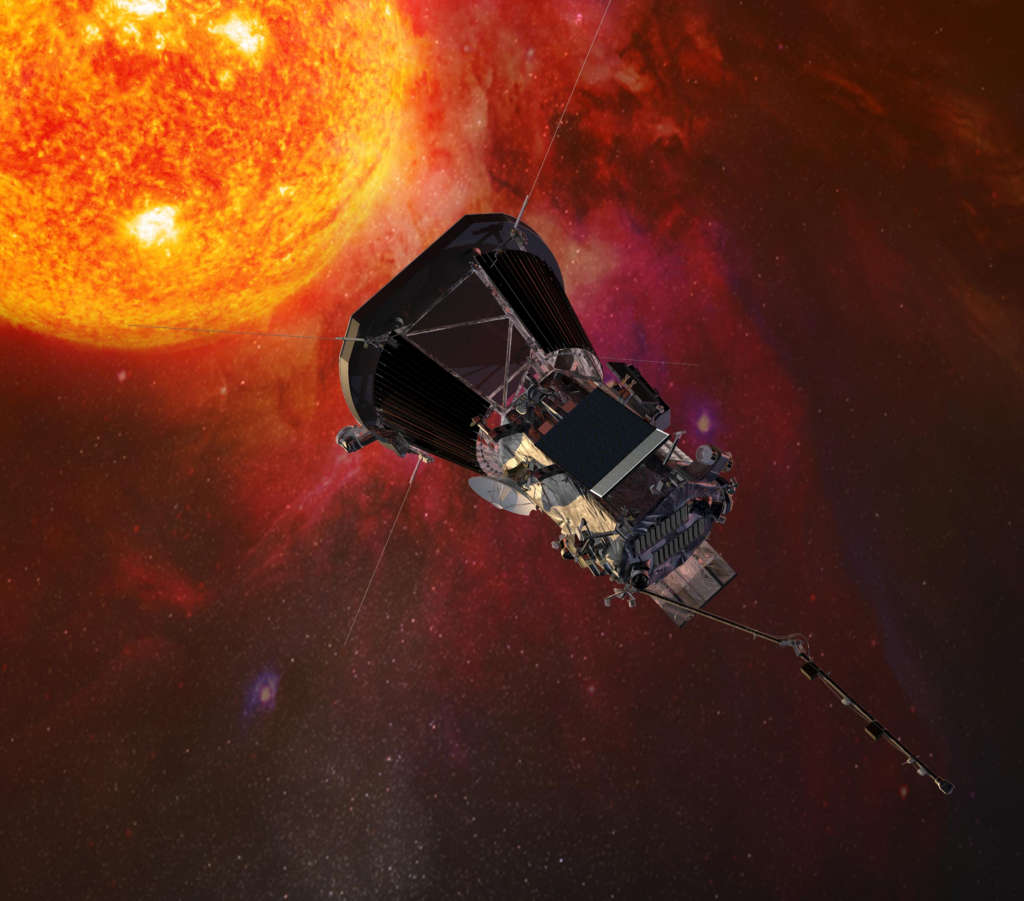
The fastest object humans have ever built is NASA’s Parker Solar Probe. On 24 December 2024 it reached 192.22 km/s, about 692,000 km/h (430,000 mph), as it passed roughly 6.2 million km from the Sun’s surface, according to Guinness World Records. That is fast enough to cross the continental United States in seconds.
It is important to be honest about what this means. Parker’s top speed is measured relative to the Sun, and it was gained by gravity assists from Venus and by falling toward the Sun, not by rocket power alone. Even at that record speed, it is travelling at only about 0.064% of the speed of light. To put it another way, light is still roughly 1,560 times faster than the fastest thing we have ever built.
| Vehicle | Approx. top speed | Share of light speed |
|---|---|---|
| Airbus A320 (cruise, ~Mach 0.78) | ~830 km/h | 0.00008% |
| Concorde (Mach 2) | ~2,180 km/h | 0.0002% |
| North American X-15 (Mach 6.7, 1967) | ~7,270 km/h | 0.0007% |
| Space Shuttle (orbit) | ~28,000 km/h | 0.0026% |
| Apollo 10 (crewed record) | ~39,900 km/h | 0.0037% |
| Parker Solar Probe (record) | ~692,000 km/h | 0.064% |
| Light | ~1,079,000,000 km/h | 100% |
Why a Spacecraft Cannot Reach the Speed of Light
The short answer: anything with mass would need infinite energy to reach light speed. This comes from Einstein’s special theory of relativity, which has been tested for over a century.
1. The energy problem
As an object speeds up, its kinetic energy does not simply rise with the square of velocity as it does in everyday life. As it nears light speed, the energy required climbs without limit. The relativistic factor (called gamma) shoots upward: at 90% of light speed it is about 2.3, at 99% about 7.1, and at 99.99% about 71.
Here is a sense of scale. Accelerating a 100-tonne spacecraft, roughly the mass of a large airliner, to just 99% of light speed would need around 5 x 10^22 joules. That is about 90 times the total energy humanity uses in a year. And that only gets you to 99%, not 100%. Reaching 100% needs infinite energy, which cannot exist.
2. The fuel problem
Rockets work by throwing mass backwards. The more speed you want, the more fuel you must carry, and that fuel itself must be accelerated, which needs more fuel. This is the “tyranny of the rocket equation.” Even a perfect matter-antimatter engine, the most efficient fuel physics allows, is nowhere near practical for a crewed ship, and we can produce only tiny amounts of antimatter today.
3. The dust problem
Space is not perfectly empty. At relativistic speeds, a grain of dust or even a single hydrogen atom hits a spacecraft with enormous energy. A speck of dust at a significant fraction of light speed could strike with the force of an explosive. Any real interstellar ship would need extreme shielding, and shielding adds mass.
4. The speed limit is built into the universe
Light speed is not just a technology barrier like the old “sound barrier.” It is a property of how space and time are connected. Only massless particles, like photons, can travel at exactly the speed of light. Nothing with mass can join them.
What Would Happen to Humans Travelling Near Light Speed?
We cannot reach light speed, but we can imagine travelling at a large fraction of it, say 90% or more. Even then, the effects on the human body and on time itself would be dramatic.
Time dilation: the traveller ages more slowly
At 99% of light speed, time on board the ship passes about seven times slower than on Earth. A trip to Proxima Centauri (4.24 light-years away) would take about 4.3 years from Earth’s point of view, but only around 7 months for the crew. If they returned, they would find that more than eight years had passed at home. This is not science fiction; it is a measured effect.
The g-force problem
Humans cannot accelerate quickly. A sustained 1g, the same as standing on Earth, is comfortable. At a constant 1g, it would take about a year of ship time to reach roughly 77% of light speed. Higher accelerations would be dangerous. Fighter pilots black out around 9g within seconds, and the body cannot survive extreme acceleration for long. So a crewed ship would need long, gentle acceleration, which in turn means more fuel and more time.
Radiation
At high speed, the thin gas and cosmic radiation of interstellar space would hit the ship like a particle beam. Passengers would face far more radiation than astronauts do today on the International Space Station. Heavy shielding or magnetic protection would be essential.
Long-term health in space
Even at today’s slow speeds, astronauts suffer muscle loss, bone density loss, vision changes, and fluid shifts. A journey lasting years would need artificial gravity, probably by spinning the ship, and strong medical support.
Social and psychological effects
Because of time dilation, travellers would return to a world that has aged far more than they have. Friends, family, and even the language and technology could have changed beyond recognition. The psychological cost of such one-way “time travel to the future” would be enormous.
The Aviation Connection: What Pilots and Engineers Already Know About Speed
Aviation has a long history of running into physical limits, and the lessons carry over to space travel.
The sound barrier
Before 1947, many engineers believed the sound barrier was impassable. Aircraft approaching Mach 1 suffered shock waves, buffeting, and loss of control. Chuck Yeager broke through in the Bell X-1, and design changes such as swept wings and powerful engines made supersonic flight possible. But the lesson is important: the sound barrier was an engineering problem, while the light barrier is a law of nature. One can be engineered around; the other cannot.
Why airliners don’t fly faster
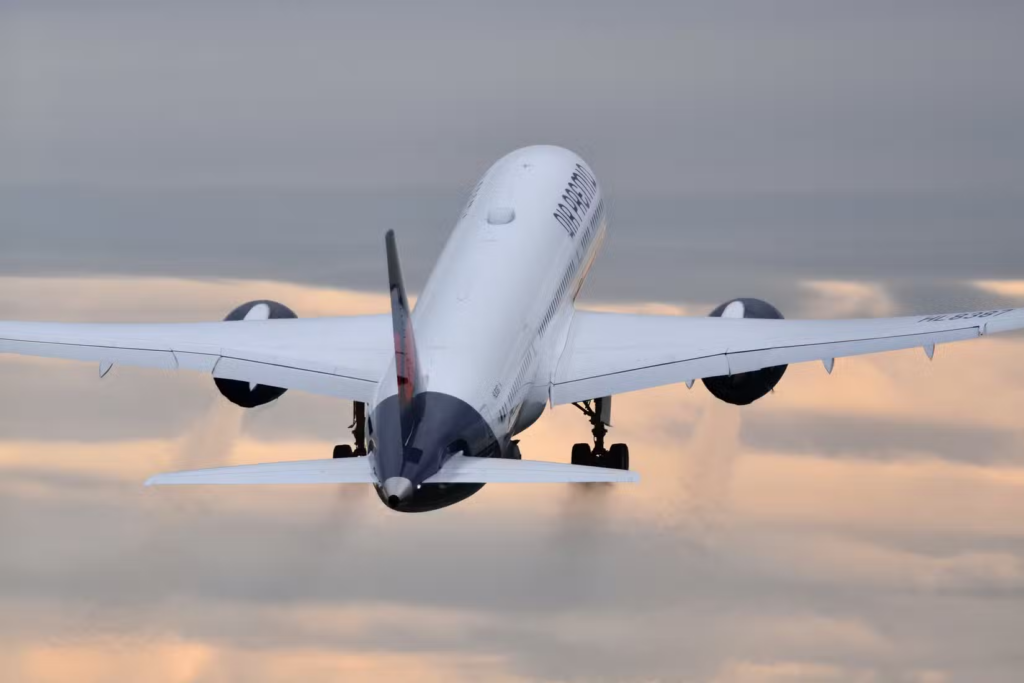
Modern airliners such as the A320 and A330 cruise at around Mach 0.78 to 0.82, not because we cannot build faster aircraft, but because of efficiency. Close to Mach 1, drag rises sharply as shock waves form over the wings. Concorde proved supersonic passenger flight was possible, but its fuel burn, noise, and cost led to retirement in 2003. In aviation and space, the highest speed is rarely the best answer. Efficiency, safety, and economics decide what actually flies.
Relativity is already in your cockpit
In 1971, physicists Joseph Hafele and Richard Keating flew atomic clocks around the world on commercial airliners and found that the clocks disagreed with ground clocks by tens to hundreds of nanoseconds, just as relativity predicted. Today, GPS satellites, which many aircraft depend on for navigation, must correct for both special and general relativity every day or position errors would build up quickly. In other words, aviation already depends on Einstein.
The maintenance perspective
From an airworthiness and engineering planning point of view, a hypothetical near-light-speed vehicle would raise questions we have never faced. How do you define flight hours or flight cycles when the crew and the ground clock disagree? How do you inspect structures subject to constant micro-impacts and radiation damage? How do you manage technical records, component life limits, and compliance tracking when a vehicle may be away for decades? Aviation maintenance is built on predictable, measurable intervals; relativistic travel would force us to rethink even that.
Could We Ever Get Close in the Future?
Scientists are exploring several ideas.
- Laser-driven light sails: Projects such as Breakthrough Starshot propose tiny probes pushed by powerful ground-based lasers to about 20% of light speed, reaching Proxima Centauri in roughly 20 years. These would be gram-scale probes, not human ships.
- Nuclear fusion propulsion: A fusion rocket could in theory reach a few percent of light speed, but no working design exists yet.
- Antimatter propulsion: The most energy-dense fuel known, but extremely costly and difficult to make and store.
- Warp drive concepts: Theoretical solutions to Einstein’s equations allow “warping” space itself rather than moving through it, but they would need exotic matter with negative energy that has never been found.
Realistically, the best near-term path to the stars is slow, unmanned, and very small. Human interstellar travel at a meaningful fraction of light speed is, at best, centuries away.
Frequently Asked Questions
What is the fastest spacecraft ever built?
NASA’s Parker Solar Probe, which reached about 692,000 km/h (430,000 mph) relative to the Sun in December 2024.
How fast was the Space Shuttle?
About 28,000 km/h (17,500 mph) in orbit, or roughly Mach 25.
Can anything travel faster than light?
Nothing with mass can reach or exceed the speed of light in normal space. Some theories, such as the expansion of space itself, allow distant regions to recede faster than light, but this does not let matter or information travel faster than light locally.
What would happen if you travelled at the speed of light?
For a massless particle like a photon, time effectively stops. For a human, reaching light speed is impossible, but nearing it would cause extreme time dilation, deadly radiation exposure, and a need for enormous energy.
Is light-speed travel possible with future technology?
According to current physics, no. Getting close might be possible with exotic technologies, but reaching exactly light speed would require infinite energy.
Conclusion
The speed of light is the ultimate speed limit of the universe, and no spacecraft, shuttle, or airliner will ever reach it. The fastest object we have ever built, the Parker Solar Probe, travels at less than one-tenth of one percent of that limit. If humans ever approach it, they will experience slowed time, extreme forces, and dangerous radiation. Aviation has shown us that every speed barrier teaches us something new, from the sound barrier to relativistic clocks in airliners, and that the real goal is not always going faster, but going farther, safely and efficiently.
Facts about the Parker Solar Probe record are based on Guinness World Records and NASA mission reporting. Other figures are rounded approximations.