When we think about how an aircraft responds seamlessly to pilot inputs, we often imagine advanced flight computers or hydraulic actuators at work. Yet, behind many control movements—particularly in general aviation and smaller aircraft—lies a beautifully simple but mechanically precise system: flight control cables.
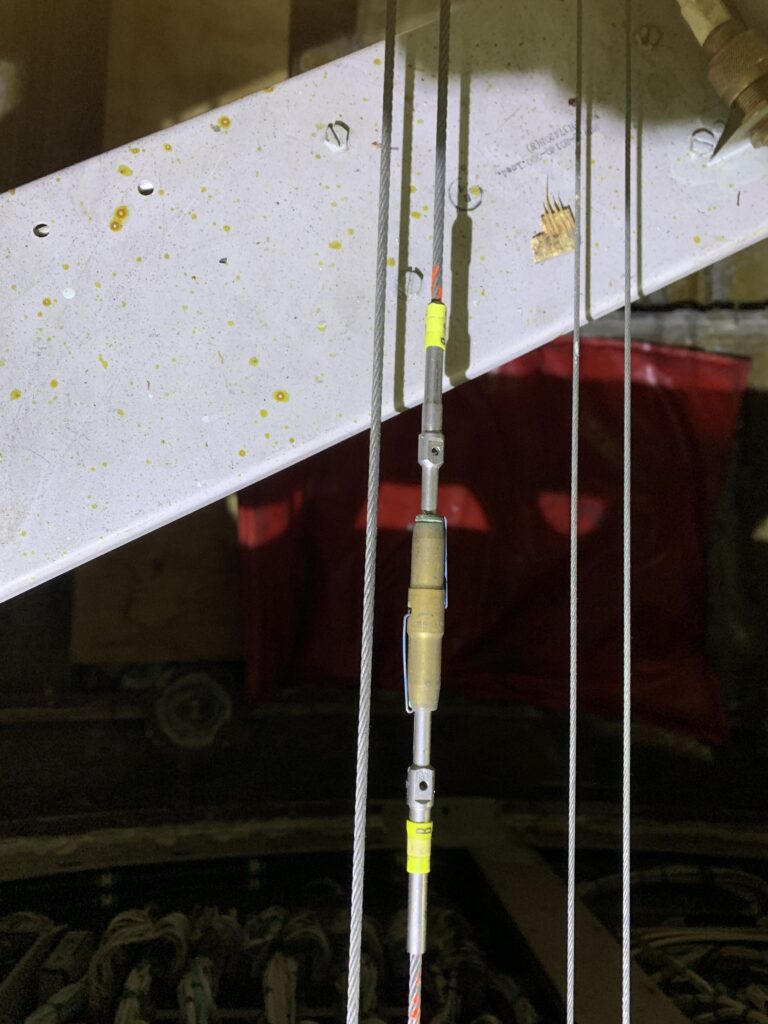
The components in a typical flight control cable run, including the turnbuckle assembly and cable guards, are critical elements in ensuring reliable and accurate control response.
⸻
Understanding the Cable System
Aircraft flight control cable systems use high-strength, flexible steel cables routed through pulleys, bellcranks, and quadrants to transmit motion from the cockpit to the control surfaces. These cables replace heavy or complex linkages, offering both weight efficiency and mechanical simplicity.
Each cable must maintain an exact tension value to ensure the correct balance between responsiveness and stability. If tension is too low, cables may sag or produce sluggish response, causing delayed control input or excessive free play. Too tight, and components such as pulleys and bearings experience excessive wear, and the control forces may become uncomfortably high.
⸻
Turnbuckles: Fine Adjustment for Precision
The turnbuckle is a small but crucial component used to adjust and fine-tune cable tension. It consists of a threaded barrel with left- and right-hand threaded ends, allowing technicians to precisely increase or decrease tension by rotating the barrel.
Once the correct tension is set, the turnbuckle is safetied with safety wire or locking clips to prevent any in-flight movement. This ensures that the adjustment remains secure even under vibration or temperature changes.
⸻
Temperature Compensation: Design Considerations
Steel cables do expand and contract with temperature changes, which can affect cable tension. However, most general aviation aircraft do not use automatic tension regulators. Instead, the cable system is designed with sufficient length and flexibility to accommodate normal temperature variations without significant tension changes.
In some larger or more complex aircraft, compensating mechanisms may be incorporated into the design, but these are not spring-loaded or hydraulic regulators attached to individual cables. Rather, compensation is achieved through design features in the control system geometry or through pilot technique adjustments.
Technicians adjust cable tension during maintenance to account for seasonal temperature differences and ensure consistent control feel across varying conditions.
⸻
Maintenance and Inspection Importance
Routine inspection of flight control cable systems is a vital aspect of aircraft maintenance. Technicians check for:
- Correct cable routing and freedom of movement
- Proper tension using a tensiometer
- Turnbuckle security and safety wire integrity
- Cable wear, fraying, corrosion, or broken strands
- Pulley alignment, rotation, and bearing condition
- Adequate clearance from structure and other systems
Even minor issues in this system can lead to degraded control feedback or mechanical failure—making precision and attention to detail absolutely essential.
⸻
Conclusion
The flight control cable system may appear simple compared to modern fly-by-wire systems, but its reliability and mechanical efficiency have proven themselves over decades of aviation history. Components like the turnbuckle embody the precision and craftsmanship that define aircraft engineering.
Every cable, fitting, and adjustment beneath the panels tells a story of engineering discipline, safety assurance, and meticulous craftsmanship—the foundation of every successful flight.
By Aeropeep Team
If you enjoy our work, please consider making a small donation—it helps us stay independent and keep delivering quality aviation content. 💙
👉 Donate
Thank you for being part of the Aeropeep journey!