Initial Findings from the Cockpit Voice Recorder (CVR)
The National Transportation Safety Board (NTSB) has released updates regarding the ongoing investigation into the UPS McDonnell Douglas MD-11 accident that occurred at Louisville Muhammad Ali International Airport on November 4, 2025, at approximately 5:15 p.m. local time.
According to NTSB spokesperson Todd Inman, the Cockpit Voice Recorder (CVR) yielded 2 hours and 4 minutes of high-quality digital audio data, providing valuable insight into the final moments of the flight. Investigators confirmed that the UPS flight crew completed their standard checklists and briefings in preparation for the flight, and the takeoff roll was uneventful through the different speed callouts.
However, approximately 37 seconds after the crew called for takeoff thrust, a repeating bell sound was heard on the cockpit voice recorder. The bell persisted for about 25 seconds until the end of the recording, which corresponds to the moment investigators believe the aircraft crashed. During this time, the crew engaged in efforts to attempt to control the aircraft before the crash.
Engine and Structural Findings
NTSB teams have focused considerable attention on the left engine (No. 1 engine) and its pylon assembly, which suffered a catastrophic failure during the takeoff sequence. According to preliminary findings, the left engine caught fire and separated from the wing during the takeoff roll.
Based on preliminary recovery data:
- The bulk of the left engine pylon remained attached to the engine when it separated from the wing
- Both the engine and the attached pylon fragments have been recovered and secured for detailed metallurgical analysis
- The separated left engine was found on the grass beside runway 17R
- Pieces of engine fan blades have also been recovered from the scene
This stage of the investigation aims to determine whether structural fatigue, maintenance-related issues, or external forces contributed to the detachment.
Maintenance Background: Heavy Check Prior to the Accident
Flight records suggest that the UPS MD-11, built in 1991 and bearing registration number N259UP, underwent maintenance while on the ground in San Antonio for more than a month, from September through mid-October 2025. NTSB member Todd Inman confirmed this maintenance period during Thursday’s briefing.
FAA maintenance records show that the jet needed a permanent repair to fix a crack in the fuel tank before it returned to service. The last date of service for the MD-11 was in September 2025.
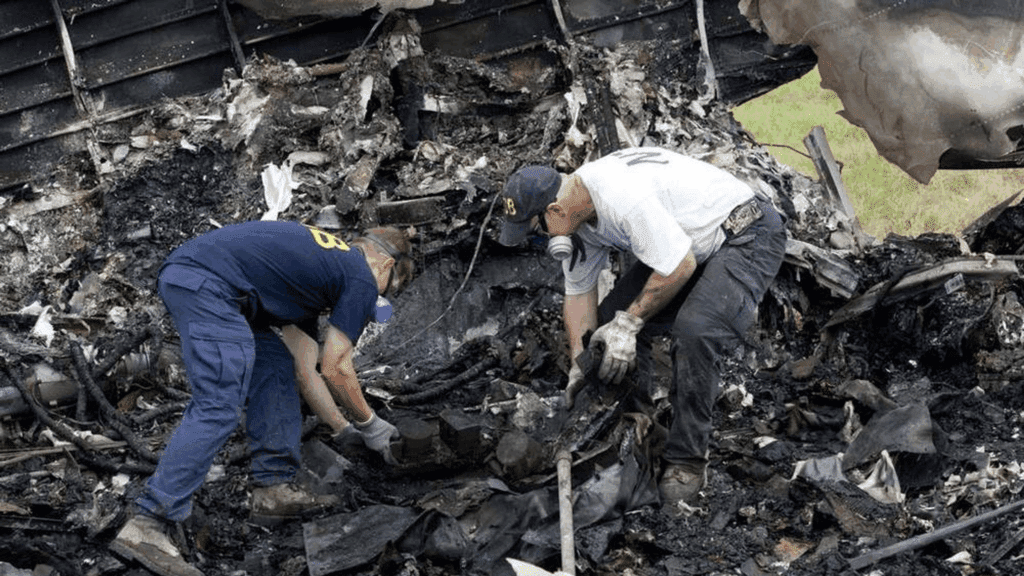
The NTSB has stated that it is closely examining all maintenance documentation and component replacement logs from that maintenance visit to identify any anomalies or deferred defects.
Flight Data Recorder Information
The NTSB successfully extracted 63 hours of flight data from the Flight Data Recorder (FDR). According to preliminary flight data, the last ADS-B message received at 5:13:32 p.m. EST showed the aircraft reached a maximum altitude of 475 feet and a speed of 183 knots (211 mph). This equated to approximately 100 feet above ground level.
During Thursday’s media update, the NTSB confirmed that Flight 2976 was traveling at a speed of 210 miles per hour at an altitude of 475 feet at the time of the last reading retrieved.
Casualties and Impact
The crash resulted in at least 14 confirmed deaths, with nine people still reported missing as of Friday, November 8, 2025. Among the deceased are:
- All three crew members aboard the aircraft: Captain Richard Wartenberg of Independence, Kentucky; First Officer Lee Truitt of Albuquerque, New Mexico; and International Relief Officer Captain Dana Diamond of Bryan, Texas
- At least 11 people on the ground, including at least one young child
- Multiple individuals remain unaccounted for
Fifteen people were initially treated for injuries at University of Louisville Health, with two in critical condition in the burn center. Thirteen patients have since been discharged.
On-Site Challenges and Material Recovery
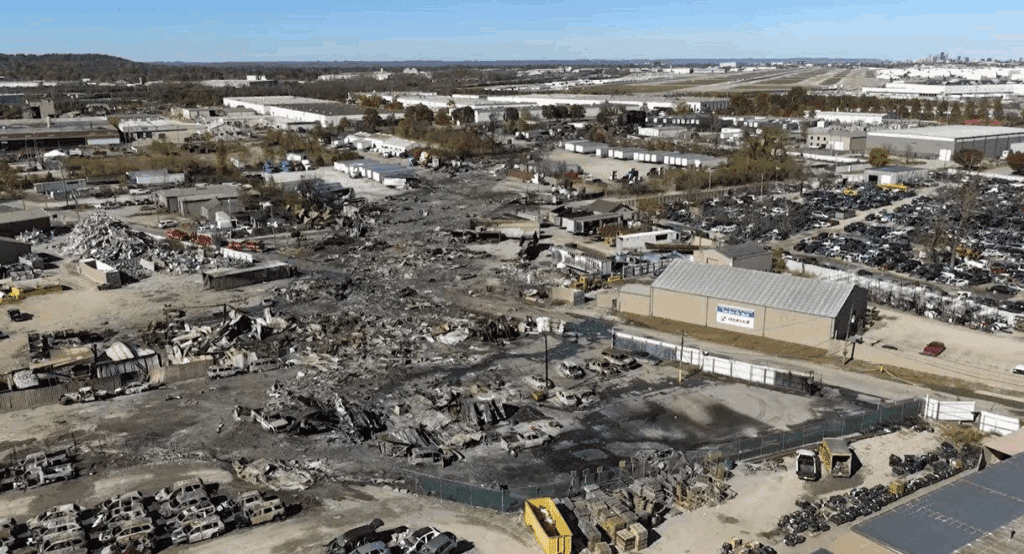
The accident site presents significant recovery challenges, as the aircraft came down in an industrial area containing an auto scrap yard (Grade A Auto Parts) and the Kentucky Petroleum Recycling company’s depot. The debris field stretches for approximately half a mile.
The plane, which was fully fueled with about 38,000 gallons of fuel for its long-distance flight to Honolulu, struck fuel tanks at the petroleum recycling facility, causing a massive fire and explosions. The left wing hit the fuel tanks, causing the aircraft to roll more than 90 degrees to the left before crashing into a semi-truck parking area and the auto scrap yard.
Specialized sorting and chemical analysis techniques are being used to differentiate aircraft components from industrial materials and existing metals at the scene. Multiple buildings were set on fire or destroyed in the crash.
UPS Cooperation and Simulator Studies
In an effort to assist the investigation, UPS Airlines has provided another MD-11 aircraft with the same type of engines for the NTSB to use as a reference model. This exemplar aircraft will be used to compare pylon structure, control linkages, and system routing with those recovered from the accident site.
Additionally, UPS has granted the NTSB access to its full-motion MD-11 simulators on-site. NTSB operations team members will utilize these simulators to study the cockpit configuration and run scenarios based on CVR data and aircraft parameters. These simulations will help investigators assess crew responses, alert tones, and possible system failures leading up to the crash sequence.
Safety Measures Taken
Out of an abundance of caution and in the interest of safety, UPS announced on Friday that it is temporarily grounding its fleet of McDonnell Douglas MD-11 aircraft. MD-11s make up approximately 9% of the UPS fleet. UPS stated they made this decision proactively at the recommendation of the aircraft manufacturer. FedEx also announced it was grounding its MD-11 fleet.
Ongoing Investigation
The NTSB emphasized that the investigation remains in its fact-gathering phase. The agency launched a go-team of 28 personnel and expects to be on scene for at least a week or longer. Investigators have organized into multiple specialized groups:
- Operations group
- Structures group
- Power plants group
- Systems group
- Maintenance group
The NTSB will also be forming a CVR technical expert group on the MD-11 at its headquarters to review the recording and produce a written transcript. The transcript will not be made public until a majority of the other factual reports are placed in the NTSB public docket for this accident, which will be several months from now.
Both the cockpit voice recorder and flight data recorder suffered some heat damage but no intrusion, and investigators were able to successfully extract data from both devices. They have been transported to the NTSB laboratory in Washington, D.C., for detailed analysis.
A preliminary report is expected to be released within 30 days, followed by a detailed final report once all forensic and engineering examinations are complete.
About the MD-11 and Its Operational History
The McDonnell Douglas MD-11, a tri-jet derivative of the DC-10, is a 200-foot-long cargo jet equipped with three engines: one on each wing and one on the tail. The type has been involved in several notable accidents over the years. UPS Airlines planned to operate about 25 MD-11 planes by the end of the year and has been phasing out the aging three-engine jets in favor of newer and more fuel-efficient two-engine freighters.
Community Impact
The crash has had significant impact on the Louisville community:
- Louisville Mayor Craig Greenberg declared the scene “apocalyptic” and “worse than the movies”
- Kentucky Governor Andy Beshear declared a state of emergency on Wednesday to aid in the response
- All public schools in the Jefferson County School District were closed the day after the crash
- A shelter-in-place order was issued for residents within a quarter-mile radius of the crash site
- Power was de-energized to nearby areas for safety reasons
- Operations at UPS Worldport, which handles 300 flights daily and sorts more than 400,000 packages an hour, were temporarily halted
- The Big Four Bridge was illuminated in yellow, one of UPS’s main colors, in solidarity with victims
- Teamsters Local 89 held a candlelight vigil at 5:14 p.m., marking the time of the crash
Louisville Muhammad Ali International Airport resumed commercial passenger flights on Wednesday morning, with runway 17R/35L reopening around 4:45 p.m. EST on Thursday, November 6, returning the airfield to full operational status.
By Aeropeep Team
If you enjoy our work, please consider making a small donation—it helps us stay independent and keep delivering quality aviation content. 💙
👉 Donate
Thank you for being part of the Aeropeep journey!