
What Counts as a Tailwind and Why Does It Matter During Landing?
A tailwind is any wind component that pushes the aircraft in the same direction it is traveling, rather than against it.
During approach and landing, this matters because an aircraft’s performance figures, including approach speed, landing distance, and climb gradients, are calculated relative to the airflow over the aircraft, not directly relative to the ground.
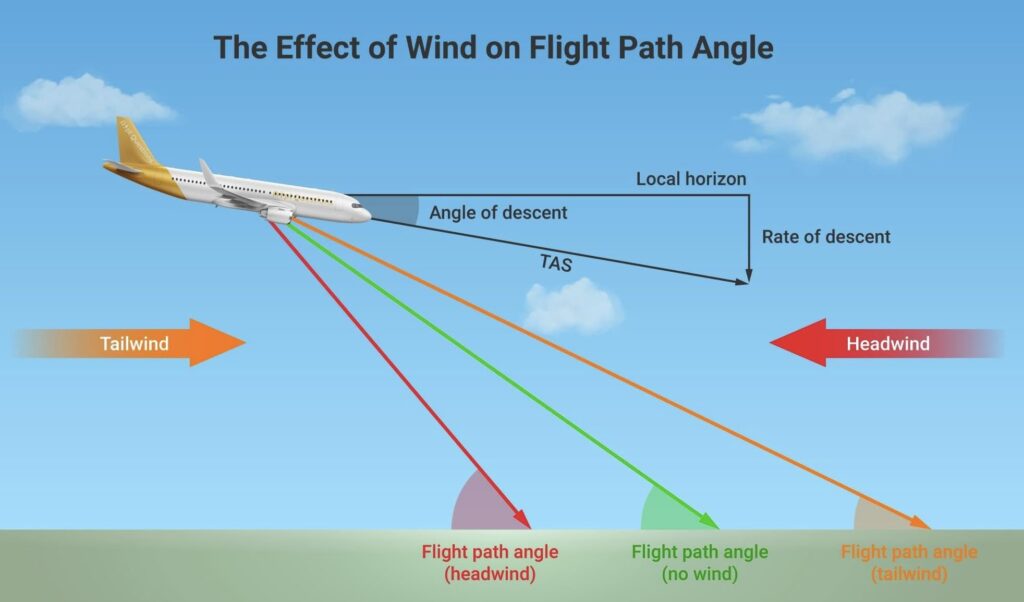
When wind is factored into a landing, controllers and pilots break it into two components:
- Headwind/tailwind component: The wind component along the runway.
- Crosswind component: The wind component across the runway.
Most operators publish a maximum demonstrated tailwind limit for landing, typically somewhere between 10 and 15 knots, depending on the aircraft type, runway surface condition, and manufacturer certification data.
Higher Groundspeed at Touchdown
This is the core of the problem.
An aircraft doesn’t fly based on groundspeed. Lift is generated by airspeed, which is the speed of the air flowing over the wings.
A pilot flies a target approach speed based on airspeed, not groundspeed, right down to the runway.
With a tailwind, the aircraft’s groundspeed at touchdown is higher than it would be in calm conditions or a headwind because the wind pushing from behind adds to the aircraft’s speed over the ground while airspeed stays the same.
For example, a 15-knot tailwind means the aircraft crosses the threshold and touches down roughly 15 knots faster over the ground than it would in still air.
That extra groundspeed has to go somewhere, and it goes directly into landing distance.
Landing Distance Increases Dramatically
Landing distance doesn’t scale in a simple straight line with speed. It scales with the square of speed because kinetic energy, the energy the brakes, spoilers, and reverse thrust all have to dissipate, is proportional to velocity squared.
This means relatively small increases in groundspeed can produce disproportionately large increases in the distance needed to stop.
As a rough rule of thumb used in performance planning, a 10-knot tailwind can increase landing distance by around 20 percent compared with a no-wind landing, and the effect compounds further as the tailwind component grows.
On a runway with limited length, marginal braking action, or a wet or contaminated surface, that additional distance can be the difference between stopping safely and running off the far end.
This is exactly why tailwind landings are one of the contributing factors in runway excursion accidents, where an aircraft overruns or veers off the side of the runway during landing.
Reduced Margin for Error on Wet or Contaminated Runways
Tailwind risk becomes more significant when combined with a wet, icy, or contaminated runway.
Braking friction is already reduced on these surfaces, so the aircraft needs more distance to stop even in calm wind.
Add a tailwind component on top of that, and the required landing distance can exceed the available runway length entirely.
This may not always be immediately obvious to the crew unless performance calculations are rerun for the actual conditions at the time of landing.
The combination of tailwind plus a degraded runway surface has been identified as a factor in multiple high-profile runway excursions.
This is why operational landing distance calculations require crews to factor in both wind and runway condition reports before committing to land.
Go-Around Performance Takes a Hit Too
Tailwind doesn’t just make it harder to stop. It can also affect the aircraft’s ability to climb away safely if a go-around is required.
During a go-around, the aircraft needs to accelerate and gain altitude while transitioning from a descending, low-power configuration to a climbing one.
A tailwind reduces the effective climb gradient relative to the ground and terrain because the aircraft is traveling over the ground faster while its airspeed and rate of climb may remain essentially unchanged.
In terrain-critical environments, or at airports surrounded by high ground, this reduced climb margin during a tailwind go-around can be a genuine safety concern and is factored into obstacle clearance planning.
Stall Margins and Approach Speed Considerations
Approach speed itself is calculated based on the aircraft’s stall speed in the landing configuration, with a safety margin added.
However, that speed is flown relative to the air, not the ground.
A tailwind doesn’t reduce the margin above stall speed the way some pilots assume because stall is fundamentally an airspeed phenomenon.
However, a tailwind does mean the aircraft is descending and closing with the runway at a higher rate relative to the ground.
This compresses the time available to stabilize the approach, correct deviations, and configure the aircraft for landing.
Less time to react is itself a safety-reducing factor, particularly during a rushed or unstabilized approach.
Reduced Effectiveness of Reverse Thrust and Spoilers
Reverse thrust efficiency is also affected by the aircraft’s speed after touchdown.
Reversers are most effective at higher speeds immediately after touchdown, but the aircraft’s overall energy state is higher to begin with during a tailwind landing.
This means the reversers, spoilers, and brakes collectively have more kinetic energy to dissipate over the stopping distance.
Engineers and performance planners therefore build specific tailwind correction factors into landing-distance charts for precisely this reason.
It isn’t simply about the extra approach speed. It is the cumulative effect on the aircraft’s overall deceleration requirements.
Regulatory and Operational Limits Exist for a Reason
Because of these compounding effects, aircraft manufacturers publish maximum demonstrated tailwind components for landing, and operators incorporate these limitations into their standard operating procedures.
Exceeding the applicable limit isn’t simply a matter of company policy.
It can mean the landing performance calculations the crew relied upon for runway length, obstacle clearance, and stopping distance no longer apply because those calculations were validated only up to the applicable tailwind limit.
Air traffic control also factors wind into runway selection.
Controllers try to assign runways aligned into the wind wherever possible. However, at busy airports with a single runway orientation, or during rapidly shifting wind conditions, crews sometimes have to accept a tailwind component within limits.
This is why understanding, respecting, and correctly calculating the applicable tailwind limit matters so much.
The Bottom Line
Tailwind during final approach and landing isn’t just an inconvenience. It is an important aircraft performance consideration.
A tailwind can:
- Increase groundspeed at touchdown
- Increase landing distance
- Reduce the available stopping margin
- Become more significant on wet or contaminated runways
- Reduce the effective climb gradient relative to the ground during a go-around
- Compress the time available to identify and correct approach deviations
- Increase the kinetic energy that must be dissipated during landing
The physics involved, particularly the squared relationship between speed and kinetic energy, means the effects can become significant as wind speed increases.
That’s why certified landing-distance data, operator procedures, and runway selection processes all take the tailwind component seriously.
Tailwind limits are not simply suggestions. They are an important part of ensuring that the aircraft’s landing performance remains within the conditions for which it has been evaluated.
Technical note: Actual tailwind limits, landing-distance corrections, and performance requirements vary by aircraft type, operator procedures, runway condition, and applicable regulations. Always refer to the applicable aircraft flight manual, performance data, and operator procedures for operational decisions.