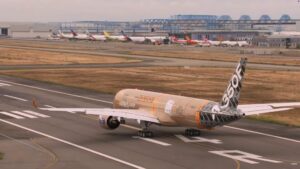
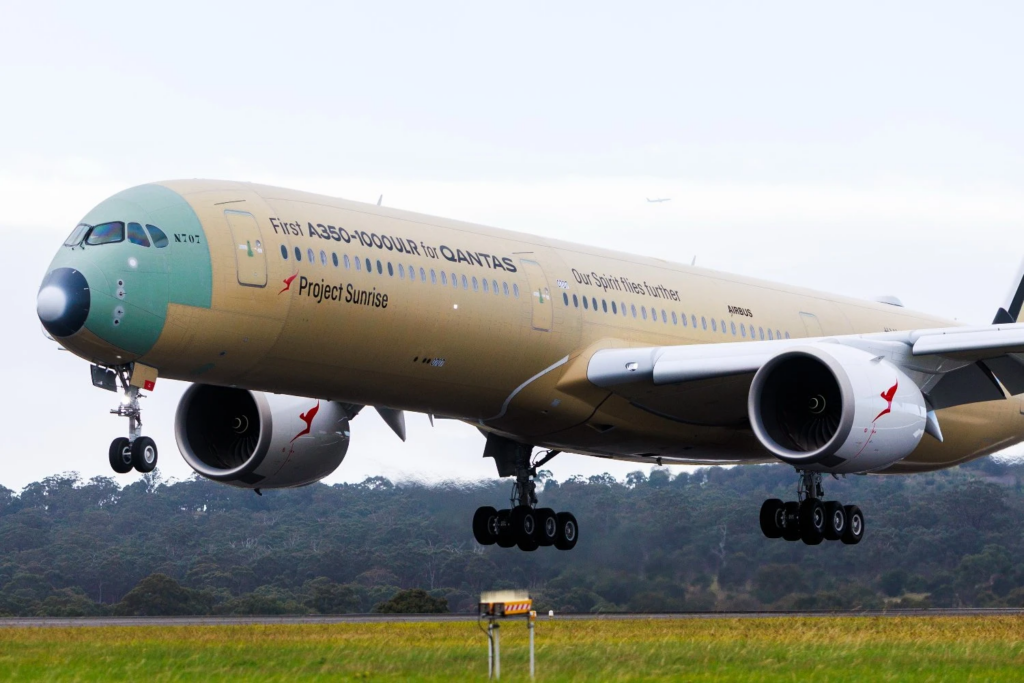
On 23-24 July 2026, an unpainted Airbus test aircraft wearing the callsign “Airbus 35LR” lifted off from Toulouse-Blagnac, climbed to 41,000 ft, and didn’t land again until it touched down in Melbourne 19 hours and 11 minutes later. The aircraft was MSN 707, the first Airbus A350-1000ULR, and the flight was one of the most significant data points yet in a program that has been years in the making: Qantas’s Project Sunrise.
The A350-1000ULR is not a clean-sheet aircraft. It’s a purpose-built derivative of the A350-1000, re-engineered to do one thing better than any other airliner in the world – stay airborne for longer. This article breaks down what actually changed under the skin, what’s happening with flight testing right now, and why this variant matters for the future of ultra-long-haul travel.
The Origin: Why Qantas Needed a New Airframe
Australia’s east coast has always been aviation’s most stubborn geography problem. Sydney and Melbourne sit roughly 17,000 km from London and around 16,000 km from New York – distances that, even with modern widebodies, have historically demanded at least one refuelling or transit stop through hubs like Singapore, Dubai, Los Angeles, or Dallas. That detour can add hours to a journey and introduce additional risk and fatigue for passengers and crew alike.
Qantas explored this problem for years under the banner “Project Sunrise” before finalising an order for 12 ultra-long-range airframes with Airbus in 2022. Neither the standard A350-900 nor the A350-1000 – despite already offering some of the longest range in the widebody category – could comfortably close the gap on a genuine nonstop Sydney-London or Sydney-New York service with full operational reserves. Airbus’s answer was to take the larger, more powerful A350-1000 and stretch its legs even further.
What Actually Changed: The Rear Centre Tank
The single defining modification on the A350-1000ULR is a new Rear Centre Tank (RCT) – a 20,000-litre (roughly 5,283 US gallon) auxiliary fuel tank integrated into the aircraft structure. This isn’t a bladder tank bolted on as an afterthought; it’s built into the airframe itself, which meant Airbus had to run a genuine structural certification campaign rather than a simple systems modification.
That extra fuel volume pushes total range from the standard A350-1000’s roughly 9,000 nautical miles out to approximately 9,700-9,800 nautical miles (around 18,000 km) – enough to comfortably cover Sydney-London or Sydney-New York nonstop, with contingency fuel for diversions built in. In flight-time terms, Airbus and Qantas have both pointed to missions of up to 22 hours.
Adding that much fuel capacity isn’t free, though. To keep the aircraft within safe structural and performance limits, Qantas’s configuration trims passenger count to 238 seats in a four-class layout – well down from the 350-480 passengers a standard A350-1000 can carry in denser configurations. That trade-off is deliberate: fewer seats and a lighter payload buys the fuel margin needed to stay airborne for the better part of a day.
The current flight test campaign is specifically built around proving out this tank and its supporting systems. Airbus’s published test programme is a 75-80 hour certification effort focused on the Fuel Quantity Management System (FQMS) – verifying that fuel transfer sequencing between the main tanks and the new rear tank behaves correctly at every phase of flight and altitude, and that all pumps, gauges, and pressure systems perform as designed across the full envelope.
Powerplant: Trent XWB-97
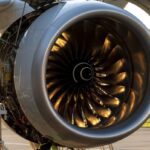
The A350-1000ULR is powered by two Rolls-Royce Trent XWB-97 engines – the same engine family that powers the standard A350-1000, and currently the most powerful turbofan ever fitted to an Airbus aircraft. Each engine is rated at roughly 97,000 lbf (430 kN) of takeoff thrust, with a maximum continuous thrust rating of around 83,100 lbf (370 kN).
The Trent XWB-97 is a higher-thrust derivative of the Trent XWB-84 that powers the A350-900, sharing the same core architecture but scaled up to handle the A350-1000’s greater mass. Rolls-Royce has reported dispatch reliability above 99.9% for the XWB-97 in service, and Airbus credits the wider Trent XWB family with roughly a 25% reduction in fuel burn and CO2 emissions compared with the previous generation of widebody engines it replaced. For an aircraft whose entire mission profile depends on maximising range per kilogram of fuel burned, that efficiency margin is not a marketing footnote – it’s foundational to the whole ULR concept.
Because of the additional fuel load, the A350-1000ULR also flies at an increased maximum take-off weight compared with the standard -1000, which itself already sits around 308 tonnes MTOW. The aircraft retains the standard A350-1000’s distinctive six-wheel (triple-bogie) main landing gear per side – a feature that distinguishes it from the four-wheel bogies on the A350-900 and helps spread the heavier aircraft’s weight across runway pavement within normal loading limits.
Cabin and Systems: Designed for the Body Clock, Not Just the Airframe
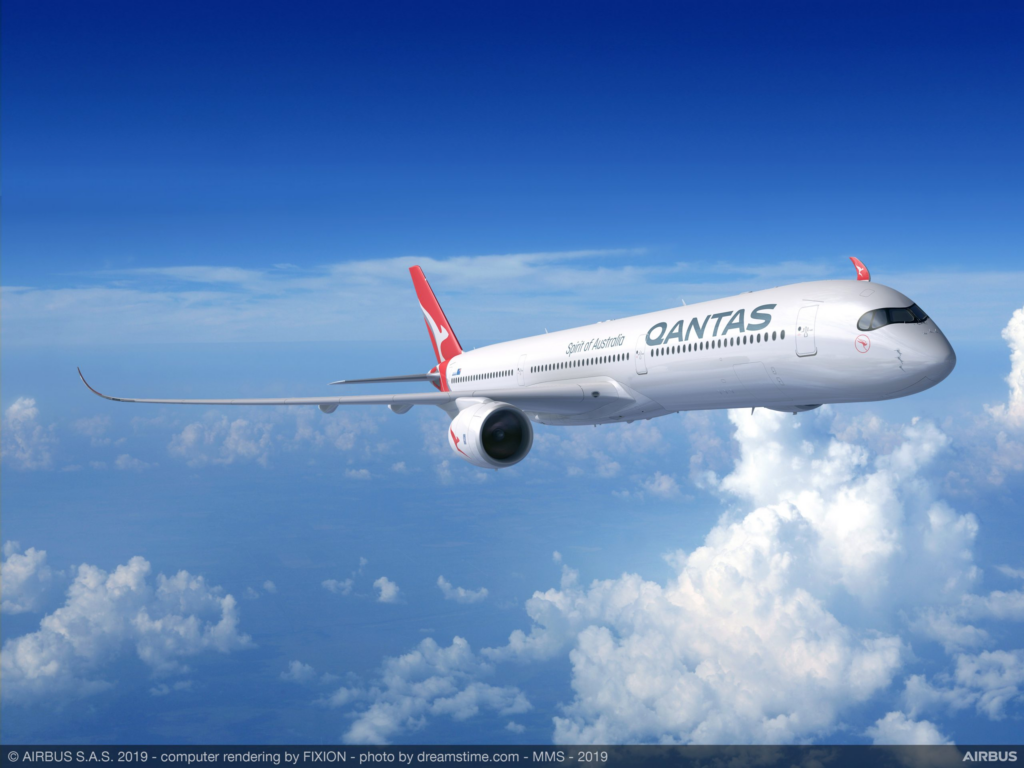
Flying for 20+ hours in one sitting creates challenges that have nothing to do with fuel tanks. Airbus and Qantas have both been explicit that the A350-1000ULR’s cabin systems were reworked specifically around physiological wellbeing on ultra-long missions, not just passenger comfort in the usual sense.
Two changes stand out. First, a new, lighter galley cooling system uses high-efficiency refrigeration units designed to cut both power draw and food odour build-up over extended flight times – a small detail that matters considerably more on a 22-hour sector than a 6-hour one. Second, the cabin is built around Airbus’s Airspace cabin concept specifically optimised for ultra-long-haul missions, with ventilation and temperature control systems that were a dedicated focus of the recent test campaign, alongside the fuel system checks.
Qantas has talked publicly about “science-backed design to minimize jetlag and maximize wellbeing” as a guiding principle for the Project Sunrise cabin – covering elements like lighting sequences, cabin humidity, and onboard movement space, aimed at reducing the physiological toll of a single ultra-long sector compared with the old approach of breaking the same journey into two shorter flights with a layover.
Recent Flight Test Milestones
The A350-1000ULR programme has moved quickly through 2026:
- April 2026 – Qantas’s first A350-1000ULR (MSN 707) rolled off the Airbus final assembly line in Toulouse.
- 2 June 2026 – The aircraft completed its maiden flight, a three-hour-43-minute sortie reaching 41,000 ft, focused on general aircraft performance checks and initial testing of the new fuel system architecture.
- 23-24 July 2026 – MSN 707 flew nonstop from Toulouse to Melbourne in 19 hours 11 minutes, routing over Italy, the Mediterranean, Egypt, Saudi Arabia, and the Indian Ocean near Sri Lanka before reaching Australia. Four Airbus test pilots and five flight-test engineers were aboard, and the aircraft reached its cruise ceiling of 41,000 ft during the sector.
- 27 July 2026 – The aircraft was scheduled to depart Melbourne on the return leg to Toulouse, with two Qantas pilots joining the crew for the journey – giving Qantas flight crew direct exposure to the aircraft ahead of entry into service.
These flights sit within a broader certification campaign expected to run for around 75-80 hours of testing, after which Airbus and Qantas are targeting delivery of the first aircraft later in 2026, with commercial Project Sunrise services planned to begin in the first half of 2027.
Where This Leaves the A350 Family
The A350-1000ULR becomes the fourth passenger variant in the A350 Family, alongside the A350-900, the Singapore Airlines-exclusive A350-900ULR, and the standard A350-1000 – with the A350F freighter still in development behind it. By the end of April 2026, the wider A350 Family had accumulated 1,579 orders from 68 customers, with more than 700 aircraft in service across 41 operators.
Qantas’s 12-aircraft order for the -1000ULR variant is comparatively small next to those numbers, but its ambition isn’t about volume – it’s about proving that a twin-engine widebody can close the last genuinely difficult nonstop city pairs left in commercial aviation. If the current test campaign clears certification on schedule, Sydney-London and Sydney-New York nonstop won’t be an engineering curiosity anymore; they’ll be scheduled flights.
Conclusion
The A350-1000ULR is a reminder that some of the most consequential aircraft programmes in modern aviation aren’t clean-sheet designs at all – they’re careful, deeply technical refinements of an existing platform pushed right up against its structural and physiological limits. A 20,000-litre fuel tank, the most powerful engines Airbus has ever fitted, and a cabin re-engineered around the human body clock rather than just comfort: together, they’re about to turn a 22-hour flight into a routine one.