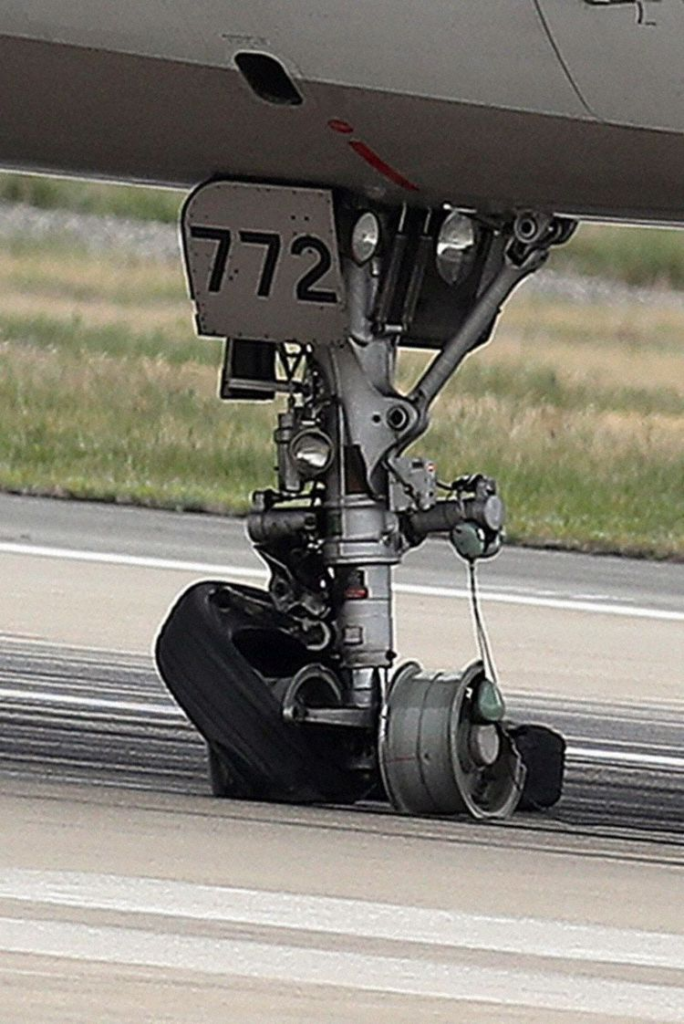
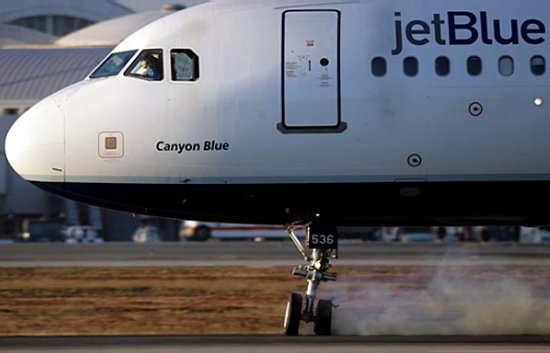
It’s one of the more unsettling sights in commercial aviation: an airliner on final approach, nose gear extended, wheels turned fully sideways instead of pointing straight down the runway. It looks catastrophic, and it has happened more often than most passengers realise — on Airbus and Boeing types alike, across two decades of recorded incidents. It’s also, almost always, survivable, precisely because the failure mode is well understood and the emergency procedures around it have been refined event by event. Here’s what’s actually going on inside the landing gear when this happens.
What “Stuck at 90 Degrees” Actually Means
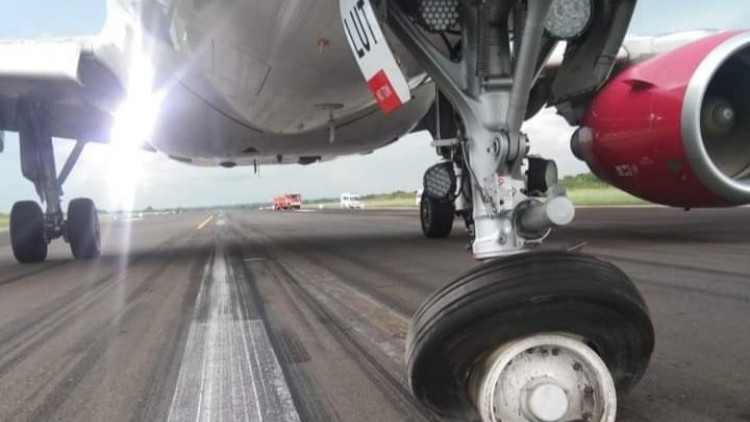
A nose wheel doesn’t rotate sideways by accident during normal flight. On the ground, the nose landing gear (NLG) steers the aircraft through a hydraulically actuated system, controlled either mechanically through the rudder pedals and a tiller, or — on fly-by-wire types like the Airbus A320 family — electronically through a dedicated control unit. As the gear retracts after takeoff, the nosewheel assembly is centred and locked straight ahead so it stows correctly in the wheel well. When it’s stuck at 90 degrees, that centring process has failed somewhere between the gear leaving the ground and the wheels needing to touch down again — leaving the tires perpendicular to the direction of travel instead of aligned with it.
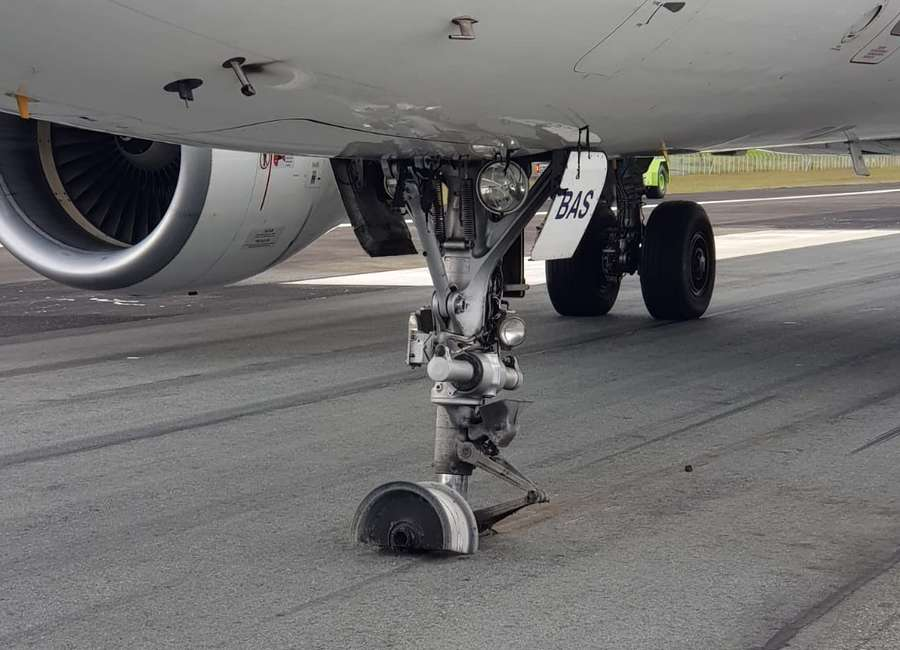
The reason this specific failure mode shows up again and again, rather than gear jamming at some random angle, comes down to how several of these steering systems are designed to fail. On the Airbus A320 family in particular, the nose gear doesn’t use a simple mechanical centring cam the way many older aircraft do. Instead, centring is managed electronically by the Brake and Steering Control Unit (BSCU), which searches for a centre-position sensor signal during gear retraction. If that signal is lost or never found — because of a wiring fault, a broken sensor target, or a mechanically damaged part upstream — the system defaults, by design, to the 90-degree position rather than leaving the wheel in an unknown or unpredictable orientation. It’s a fail-safe behaviour, not a random malfunction: engineers built the logic to fail toward a known, describable state rather than an ambiguous one.
The Failure Chain: What’s Actually Breaking
Investigations into real-world events have traced the root cause back to several distinct — and importantly, unrelated — failure points, which is part of why Airbus’s own safety publications have had to explain that not every 90-degree nosewheel event shares the same cause.
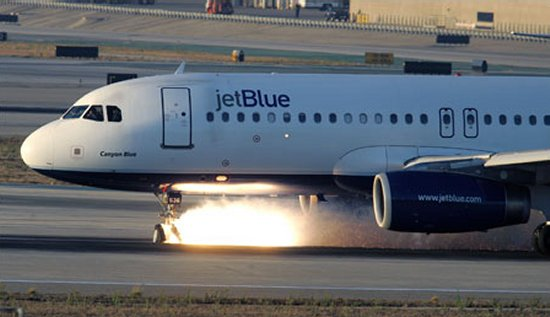
Anti-rotation lug fractures. In the widely reported JetBlue Flight 292 event at Los Angeles in 2005, post-incident inspection found that two of four anti-rotation lugs on the nose gear’s upper support assembly had fractured and separated, with the remaining two cracked. Those lugs exist specifically to stop the lower strut assembly from rotating freely; once enough of them fail, the wheel has nothing holding its orientation, and centring authority is lost. Airbus responded to that event with an Operations Engineering Bulletin describing an in-flight reset procedure for the BSCU, and JetBlue went on to modify the nose gear support fitting and upgrade the control unit across its fleet within months.
O-ring seal degradation in the steering module. An earlier wave of A320 nosewheel-cocking events in the 1990s was traced to seal failures inside the landing gear’s steering module hydraulics, serious enough that regulators issued a mandatory airworthiness directive requiring inspection and rework across operators’ fleets. This is a good example of a fault that looks identical from the tower’s binoculars — nosewheel sideways on approach — but originates from an entirely different component than a fractured lug.
Steering sensor or wiring faults. More recent events, including a 2022 LATAM Airbus A320 incident at Medellín, have been linked to nose gear steering fault indications after tire or sensor damage sustained during takeoff, again triggering the BSCU’s default-to-90-degrees fail-safe rather than a controlled, mechanically driven jam.
Undetermined jams on other airframes. Not every case involves the A320’s electronic centring logic at all. Boeing types have experienced their own nosewheel steering anomalies — a Canadian Transportation Safety Board review identified eleven similar uncommanded nosewheel steering occurrences across various Boeing aircraft over roughly two decades, most of which investigators could not conclusively diagnose after the fact, partly because flight data recorders on many of these aircraft don’t capture parameters from the nosewheel steering system itself. In several cases, the jam appeared to have cleared on its own before maintenance teams could inspect the mechanism, leaving the underlying trigger unresolved.
A Pattern Across Two Decades, Not a One-Off
Looking at the documented cases side by side makes clear this isn’t a single freak occurrence but a recurring, if rare, failure mode with a real track record. An America West A320 suffered the same fault landing at Port Columbus in February 1999, with damage limited to tires and rims. The far more widely publicised JetBlue Flight 292 followed in September 2005, broadcast live on cable news as the aircraft circled for hours before landing at LAX. A KLM Boeing 737-400 experienced a related but distinct nosewheel steering disturbance departing the runway laterally at Barcelona in 2004, traced back to a bird strike on a prior takeoff rather than a mechanical or electronic centring fault. More recently, a LATAM Airbus A320 landed with its nose gear rotated 90 degrees at Medellín in March 2022, and Asiana and Batik Air A320s have both had broadly similar events reported in the years since. Spread across manufacturers, operators, and root causes, the common thread isn’t a single design flaw — it’s that nose gear steering systems, however they’re engineered, all have to resolve to some wheel orientation when something upstream goes wrong, and a fully sideways 90-degree position is the one several major designs have converged on as the safest default.
Why the Fix Isn’t Simple: The Fuel-Burn Problem
Once a crew confirms — usually via a tower flyby or ground observation, since many aircraft have no direct cockpit indication of nosewheel angle — that the nose gear is cocked sideways, the response is almost entirely about managing the landing itself rather than fixing the fault in flight.
Because a sideways nosewheel generates far more drag and side-loading on touchdown than a properly aligned one, crews typically choose a runway with maximum available length and the best emergency response coverage, exactly as JetBlue’s captain did in choosing Los Angeles International over a return to Burbank. On aircraft without a fuel-dump capability, like the A320 family, crews will fly extended holding patterns — sometimes for several hours — purely to burn down to a lighter landing weight, reducing the structural load the twisted nose gear has to absorb and lowering the risk of fire or a full gear collapse on contact.
The landing technique itself is also deliberately different from normal. Pilots typically avoid reverse thrust, ground spoilers, and aggressive autobraking immediately on touchdown, since abrupt deceleration forces increase the load transferred through the twisted nose gear strut precisely when it’s most vulnerable. Instead, the priority is a soft, low-sink-rate touchdown that keeps weight on the main gear for as long as possible, easing the aircraft down to a stop rather than forcing it. Sparks and even brief flames from the nosewheel rims contacting the runway are a visually alarming but largely expected part of this kind of landing, and have occurred in multiple documented events without leading to a serious fire.
The MRO and CAMO Angle
For maintenance and engineering planning teams, this failure mode is a good illustration of why landing gear steering components get disproportionate attention in scheduled inspection programs relative to how rarely they actually fail. A single fractured anti-rotation lug or a degraded steering-module seal can sit undetected through multiple flight cycles before it manifests as a full-blown 90-degree jam, which is exactly why manufacturers have repeatedly followed these events with targeted service bulletins and, in the O-ring case, a mandatory airworthiness directive rather than relying on standard scheduled maintenance intervals alone. It’s also a reminder of how much diagnostic value is lost when a system isn’t monitored by the flight data recorder — several of the unresolved Boeing occurrences might have had a clearer root cause if nosewheel steering parameters had been captured alongside the rest of the flight data.
The Takeaway
A nosewheel stuck at 90 degrees looks like a single, dramatic failure, but it’s really the visible end point of several different possible failure chains — a fractured lug, a degraded seal, a damaged sensor, or a wiring fault — all funnelled through the same fail-safe design logic into the same recognisable, sideways-wheel outcome. That’s arguably the most important engineering lesson in the whole story: when you can’t guarantee a system will always centre correctly, the next best thing is making sure it fails into a state that’s predictable, visible, and survivable — which is exactly what these landings, dramatic as they look on approach, have consistently turned out to be.
By – Aeropeep Team