Walk under any widebody jet on the ramp and one of the first things that catches an engineer’s eye is the main landing gear bogie — the multi-wheel truck that carries the aircraft’s weight on the ground. Two of the most common widebodies flying today, the Airbus A350 and the Boeing 777, take noticeably different approaches to this problem. The A350 uses a four-wheel main bogie on each leg, while the 777 uses a six-wheel bogie. At first glance this looks like a simple parts-count difference, but it actually reflects two different philosophies around aircraft weight, runway loading, maintenance burden, and — ultimately — operating cost. This article breaks down why the two manufacturers made different choices, what it means for structural and unsprung weight, and how it translates into fuel and maintenance economics.
The Basic Layout
The A350 main landing gear consists of two main gear legs, each fitted with a four-wheel bogie, giving eight main wheels in total, plus a twin-wheel nose gear for a total of ten wheels on the ground. The A350-1000, being heavier, also uses a semi-levered main gear to improve rotation performance, but the wheel count on the bogie itself remains four per side.
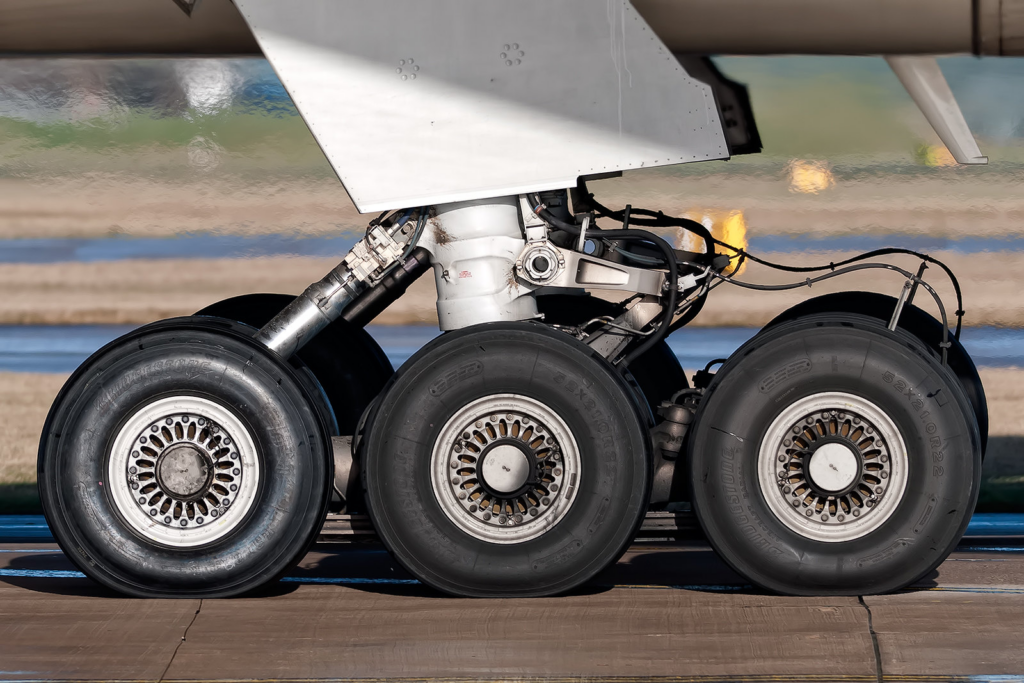
The Boeing 777 main gear, by contrast, uses two main gear legs each carrying a six-wheel bogie — twelve main wheels in total — plus a twin-wheel nose gear, for fourteen wheels overall. This six-wheel bogie was actually a first for a Boeing twinjet when the 777 was introduced in the 1990s, and it remains one of the aircraft’s most recognizable features.
The difference in wheel count is not arbitrary. It comes down to how each manufacturer chose to manage ground loads relative to aircraft weight, gear geometry, and pavement standards.
Why the Wheel Count Differs: Weight and Ground Loading
Landing gear design is fundamentally a balancing act between total aircraft weight, the number of wheels sharing that weight, and the load each individual tire and brake unit can safely absorb. Airports classify runway and taxiway pavement strength using the Aircraft Classification Number / Pavement Classification Number (ACN/PCN) system, and a big part of gear design is making sure an aircraft’s ACN doesn’t exceed the PCN of the pavements it needs to operate from.
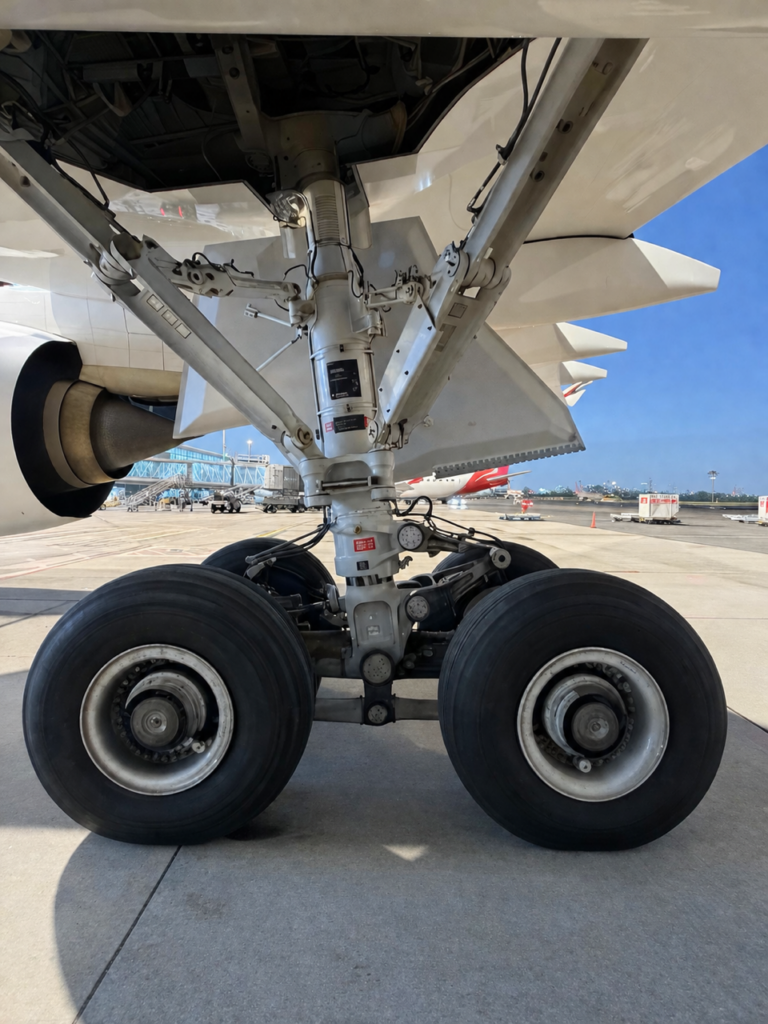
Spreading an aircraft’s weight across more wheels lowers the load on each individual tire and reduces the concentrated stress transmitted into the pavement. This is one reason very heavy aircraft — such as the 777-300ER, with a maximum take-off weight in the region of 351 tonnes, or aircraft like the A380 with its four-legged main gear and multiple bogies — use more wheels than lighter types.
The A350-900 has a maximum take-off weight of roughly 280 tonnes, and the A350-1000 around 319 tonnes. The 777-300ER, at up to roughly 351 tonnes, is meaningfully heavier. Boeing’s decision to use a six-wheel bogie on the 777 reflects the need to keep per-tire loading, brake energy absorption, and pavement footprint within acceptable limits for a heavier airframe operating from the same range of airports as lighter twinjets. Airbus, with a lighter overall airframe on the A350, was able to achieve acceptable per-tire loads and braking performance with a four-wheel bogie, keeping the gear simpler and lighter.
It’s also worth noting that wheel count interacts with brake sizing. More wheels means more individual brake units, which increases total available kinetic energy absorption during a rejected take-off or heavy landing, but also increases the number of brake assemblies that need to be inspected, overhauled, and eventually replaced.
Weight Comparison: More Wheels Isn’t Free
A six-wheel bogie is intrinsically heavier than a four-wheel bogie of similar design generation, simply because it carries two additional wheel-tire-brake assemblies, a longer and more heavily reinforced bogie beam, additional axles, and the associated hydraulic and sensor wiring for each extra wheel. This added mass sits largely as unsprung weight — weight that isn’t supported by the shock absorber (oleo strut) — which matters for two reasons.
First, unsprung mass affects how loads are transmitted through the gear during landing impact, taxiing over pavement joints, and braking. Engineers have to design the strut, bogie pivot, and trunnion fittings to handle these dynamic loads, which in turn feeds back into structural weight elsewhere in the gear and the wing or fuselage attachment points.
Second, every kilogram in the landing gear is a kilogram that isn’t available for payload or fuel, and it’s a kilogram the aircraft has to accelerate, decelerate, and in some phases effectively “carry” through the flight in terms of the structure needed to support it. This is why gear design is such a closely optimized part of the aircraft — not just for cost, but for overall aircraft efficiency.
In relative terms, the A350’s four-wheel bogie main gear assembly is lighter than the 777’s six-wheel bogie assembly, even accounting for the A350’s use of more composite structure elsewhere in the gear and airframe. Composite content in the A350’s gear components and use of newer-generation alloys helps offset some of this, since Airbus designed the A350 gear more recently than the original 777 gear architecture, benefiting from newer materials science. But wheel count itself remains the dominant factor: two fewer wheels per bogie is a straightforward, mechanical weight saving.
Fuel Burn Implications
Landing gear weight is a relatively small fraction of an aircraft’s overall empty weight, but on long-haul widebodies where every kilogram is scrutinized, it still matters. A lighter gear assembly contributes, in a small but real way, to a lower operating empty weight, which reduces the fuel burned to carry that structural weight across a flight.
It’s important to be realistic about scale here: gear weight differences between aircraft of different generations and sizes are influenced by dozens of factors beyond wheel count alone — wing design, engine efficiency, fuselage cross-section, and composite usage all dominate the fuel burn comparison between the A350 and 777. Airbus markets the A350 as offering meaningfully lower fuel burn per seat than the original 777, but this is driven primarily by newer-generation engines (Trent XWB) and a higher composite airframe fraction, not landing gear wheel count in isolation. The bogie design should be understood as one contributing factor within a much larger efficiency picture, rather than the primary driver.
That said, within an apples-to-apples “next-generation gear versus legacy gear” comparison, a lighter four-wheel bogie assembly with modern materials does provide a small, genuine, and compounding fuel saving over the life of the aircraft, because weight savings recur on every single flight cycle.
Maintenance Cost Comparison
This is where the wheel-count difference has some of its clearest, most tangible effects. Landing gear maintenance costs scale strongly with the number of wheel, tire, and brake units fitted:
- Tire changes: A six-wheel bogie has 50% more main tires to inspect, monitor for wear, and replace compared to a four-wheel bogie (twelve main tires versus eight). Each tire change involves jacking, wheel removal, torque checks, and balancing.
- Brake units: More wheels generally means more individual brake assemblies, each requiring wear-pin inspections, periodic overhaul, and eventual replacement. Carbon brake packs are a significant recurring cost item on any widebody, and the 777’s six-wheel configuration carries a proportionally larger brake inventory to manage.
- Wheel bearings and axle hardware: Each additional wheel station means additional bearings, seals, and axle sleeves subject to wear, lubrication schedules, and periodic replacement.
- Bogie beam and pivot inspections: A larger bogie beam with more attachment points has more structural detail to inspect during scheduled checks, adding incremental non-destructive testing (NDT) time.
For an airline running a mixed widebody fleet, these differences show up clearly in component-level maintenance cost per flight hour. Fewer wheel stations on the A350 gear translates to a lower recurring parts and labor burden for tires, brakes, and bearings, even though each individual A350 tire may run at a higher relative load than a 777 tire of similar design generation.
Approximate Savings
Exact OEM cost figures are proprietary and vary by airline, maintenance contract, and region, so any numbers here should be read as broad industry-order-of-magnitude estimates rather than precise figures:
- Tire and wheel maintenance: Roughly proportional to wheel count, a four-wheel-per-leg configuration can see on the order of 30–40% fewer main tire changes over a comparable utilization period than a six-wheel-per-leg configuration, simply due to fewer units in service.
- Brake maintenance: Similarly, fewer brake units can translate to meaningfully lower recurring brake overhaul costs per flight hour, though this is also strongly influenced by route profile (short-haul, high-cycle operations wear brakes faster than long-haul cruising).
- Structural weight saving: A lighter four-wheel bogie assembly, combined with the A350’s broader use of composites and modern alloys in the gear structure, contributes a small single-digit percentage to overall empty weight reduction relative to a heavier six-wheel gear architecture — a contribution that compounds into fuel savings across the aircraft’s operational life, but should not be mistaken for the dominant source of the A350’s fuel efficiency advantage over the 777.
Conclusion
The difference between the A350’s four-wheel main bogie and the 777’s six-wheel main bogie isn’t a cosmetic design quirk — it’s a direct consequence of aircraft weight, pavement loading requirements, and brake energy needs. The 777, being a heavier aircraft in most variants, needs more wheels to keep per-tire loads and pavement stress within limits. The A350, being lighter and benefiting from a newer generation of materials and structural design, achieves adequate ground loading performance with fewer wheels, at a genuine — if modest — saving in gear weight, tire and brake maintenance burden, and, by extension, fuel cost per flight cycle. For maintenance planners and engineers, the practical upshot is straightforward: fewer wheel stations on the A350 gear mean a smaller recurring parts and labor footprint, while the 777’s additional wheels buy the structural margin needed to safely operate a heavier airframe from the same runways.
By – Aeropeep Team